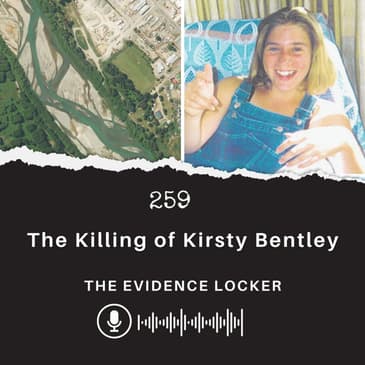
The last day of 1998 dawned hot and bright over Ashburton, a mid-Canterbury town on New Zealand's South Island. The temperature climbed to 34 degrees Celsius. Families cooled off in the shallows of the Ashburton River. Holiday traffic hummed along State Highway 1. It was, by every outward measure, a perfect New Zealand summer's day — the last one that a fifteen-year-old girl named Kirsty Bentley would ever see.
At some point in the mid-afternoon, Kirsty leashed up her black Labrador cross, Abby, and walked out the front door of the family's red brick bungalow at 165 South Street. She didn't tell her brother she was going. She just went. It was a familiar routine — the river, the fresh air, the company of her dog. Nothing about it would have seemed unusual to anyone watching her walk down Chalmers Avenue towards the water.
She never came back.
In the twenty-six years since Kirsty Bentley disappeared on New Year's Eve, her case has become one of the most haunting unsolved murders in New Zealand history. Hundreds of people have been interviewed. Dozens of suspects have been investigated and cleared. Advances in forensic science have been brought to bear on the evidence. And still — no arrest. No conviction. No answers for the family who has been waiting for them ever since.
You are listening to: The Evidence Locker.
Thanks for listening to our podcast. This episode is made possible by our sponsors—be sure to check them out for exclusive deals. For an ad-free experience, join us on Patreon, starting at just $2 a month, with 25% of proceeds supporting The Doe Network, helping to bring closure to international cold cases. Links are in the show notes.
Our episodes cover true crimes involving real people, and some content may be graphic in nature. Listener discretion is advised. We produce each episode with the utmost respect for the victims, their families, and loved ones.
Kirsty Marianne Bentley was born on 18 January 1983 at Christchurch Women's Hospital — which meant that when she vanished on New Year's Eve 1998, she was just seventeen days away from turning sixteen. She was the second child of Jill and Sid Bentley and her brother, John, was four years older than her.
Kirsty's mother Jill has described her daughter as vibrant, honest and compassionate. She was confident and direct with people she knew, but could be shy and reserved with strangers — a quality that many teenagers share. She had a strong creative streak that she channelled into drama classes and poetry. At Ashburton College she was well-liked, with a close-knit circle of friends. At the time of her disappearance, she had recently started dating a boy from one of her classes.
Ashburton itself is a town of around twenty thousand people, sitting on the Canterbury Plains about 85 kilometres south-west of Christchurch. It is the kind of place where people know their neighbours, where a teenage girl walking her dog on a summer afternoon is not a cause for alarm. That ordinariness is part of what makes what happened so difficult to comprehend — and so difficult to solve.
On the morning of 31 December 1998, Kirsty met a friend at the Ashburton library at around
10:30am. The two girls did some shopping, then had lunch together at McDonald's around midday. In the early afternoon, they visited a friend who was working locally. At around
2:30pm, the friend's sister dropped Kirsty home.
When she walked back through the front door, her brother John told her that her boyfriend had called and left a message. Phone records show she called him back at
2:38pm, but he wasn't home, so she left a message in return. After that, at some point in the early afternoon, Kirsty decided to take Abby for a walk. John didn't hear her leave the house.
At
3:05pm, a neighbour saw Kirsty walking past his home with the dog, heading in the direction of the Ashburton River. An eleven-year-old girl named Sarah Ward, riding her bike on Chalmers Avenue, waved to Kirsty as she passed. Sarah knew her well. She watched Kirsty walk towards the riverbank, Abby trotting at her side. Sarah Ward would later become one of the last people confirmed to have seen Kirsty alive.
At
4:30pm, Kirsty's boyfriend called back. That was when John realised his sister still hadn't come home. When their mother Jill returned from work at around
5:15pm, John immediately told her Kirsty was missing. Jill walked Kirsty's usual route down to the river, but found nothing and turned back, increasingly anxious. She and John agreed to wait until 6pm before searching again, in case Kirsty came home on her own.
Shortly after John left to search the route again, Kirsty's father Sid arrived home. When he was told his daughter was missing, he called the police immediately. From that moment, the search rapidly grew in scale. Friends, family and officers canvassed the area throughout the entire night. Nothing was found.
The official search and rescue operation began at 8am on New Year's Day, 1999. At around 10am, searchers made the first significant find: the family dog, Abby, tied to a tree in a patch of dense foliage beside the Ashburton River, close to Robilliard Park. The general area had been searched the previous night, but the dense scrub had concealed the dog in the dark. Near her were two items of clothing: a pair of underwear and boxer shorts, both later confirmed to belong to Kirsty.
The dog lead around Abby's neck was of the same type the Bentley family owned, though initially the family wasn't certain it belonged to them. The underwear was harder to explain. Someone had deliberately tied the dog to the tree and left Kirsty's clothing nearby. Whether that someone had taken Kirsty away, or whether something else had happened, police could not yet say.
Over the following sixteen days, police and volunteers conducted one of the largest searches in the region's history. Troops from Burnham Military Camp were deployed to assist. The search expanded outward from Ashburton to cover a much wider area of Canterbury. It was covered intensively by news media, and the story dominated front pages and news bulletins across the country. Kirsty's mother Jill appeared on television, pleading for anyone with information to come forward.
It was those television appearances that, indirectly, led to the discovery of Kirsty's body.
On 17 January 1999 — the day before Kirsty would have turned sixteen — two men were out near Camp Gully Creek, a remote area off State Highway 72 in the Rakaia Gorge, roughly 40 kilometres from Ashburton. They were searching for a cannabis patch. Hidden in a dense patch of overgrown scrub and planted pine, at the bottom of a steep embankment, they found a badly decomposed human body.
Initially the men were reluctant to contact police, given what they had been doing when they found her. But they had seen Jill Bentley on the evening news and felt they could not stay silent. They came forward. Police closed the scene and ordered a no-fly zone over the area while they conducted their examination.
The body was formally identified three days later using dental records. It was Kirsty.
She had been placed at the bottom of the embankment in the foetal position, fully clothed in what she had last been seen wearing, with the exception of the underwear found at the river. She was wearing a black tank top, a blue sarong with a white butterfly pattern, and black Colorado shoes. A hair scrunchie was on her wrist, and her hair was loose and down — something her friends later noted was unusual, because Kirsty almost never left the house for a walk with her hair untied.
Her body had been covered with a thin layer of branches and leaves. The location required carrying her 54-kilogram frame down a steep embankment in a remote area, accessible only by vehicle via State Highway 72. The pathologist noted this would have been no easy task.
A post-mortem was conducted at Christchurch Hospital. Because Kirsty's body was in an advanced state of decomposition after spending two weeks in the summer heat, a full examination was complicated. Police initially withheld the cause of death from the public for operational reasons.
What the pathologist, Dr Martin Sage, determined was this: Kirsty had been killed by a single blow — or blows — of blunt force trauma to the right side of the back of her head. The injury had fractured her skull severely. Dr Sage's finding was that the injury would have caused immediate loss of consciousness, and that death would have followed within seconds or minutes. She would have had no warning and no chance to fight back. The pathologist believed she was killed soon after she went missing that afternoon, and that her body was transported to Camp Gully the same night. The decomposition of her body made it impossible to determine whether she had been sexually assaulted.
It was not until 15 July 2016 — eighteen years after Kirsty's death — that a Coroner's Inquest was held. Coroner Peter Ryan confirmed that Kirsty had died on 31 December 1998, at an unknown location, as a result of a massive blow to the head. He ruled that her death was not accidental. He offered his condolences to the family and noted, pointedly, that it was deeply unfortunate the perpetrator had never been brought to justice.
The investigation into Kirsty's murder was named Operation Kirsty and has remained active, in one form or another, for more than two decades. The cold case file has grown to more than seventy archive boxes, containing four hundred folders of documents and evidence. Hundreds of people have been interviewed. At various points the list of people of interest has stood at 140; at others it has been reduced to as few as twenty. None have been charged.
From the very beginning, police concentrated much of their attention close to home. Within the family.
Kirsty's father, Sid, was a former Royal Navy sailor who had settled in Ashburton. On the day Kirsty disappeared, his whereabouts were unclear. He initially told police he had been in Christchurch and Lyttelton. Later, he said he had hit his head on a cupboard door and forgotten that he had actually been in Ashburton for part of the day — and he later reverted to his original account. His exact movements on 31 December 1998 have never been definitively established. His vehicle, a Holden Kingswood ute, was examined by police. No evidence linking him to his daughter's death was found.
Kirsty's brother John, who was nineteen at the time, was also treated as a suspect. He was the last known person to see Kirsty inside the house, and one theory circulating among investigators was that he may have killed his sister and that Sid helped him dispose of the body. John has said police appeared to believe he was jealous of Kirsty because she had a boyfriend. He has consistently denied any involvement and acknowledged publicly that it made sense for police to consider family members first.
Police conducted Luminol testing at the family home in the early stages of the investigation. Nothing of value was found. The family was described by some nearby residents as a little dysfunctional, though what that means in practice, and whether it has any bearing on the case, has never been established. What is clear is that the suspicion that fell on Sid and John caused enormous damage. Jill Bentley separated from Sid following Kirsty's death. The couple never reconciled.
Sid Bentley spent the rest of his life under a cloud. He remained in Ashburton, sitting with his smoke-stained hands in a cluttered lounge, the one picture he kept clean being a photograph of Kirsty. He died of oesophageal cancer in June 2015, aged 64, having never been charged with anything. He maintained his innocence until the end. After his death, his mother publicly stated, for the first time, that she did not believe Sid or John had been involved in the murder. John, who now lives in the United Kingdom, has said he is haunted by the fact his father died believing people thought he was a liar.
It is worth noting, too, that when Sid's will was released, his son John was excluded from the estate.
Early in the investigation, police appealed for information about a distinctive green Commer van that had been seen in the Ashburton area in the weeks before Kirsty's disappearance. A mechanic, who had done his apprenticeship on Commer vans and could therefore identify one precisely, reported seeing it driving slowly down Chalmers Avenue — about 200 metres from where Abby and Kirsty's underwear were later found — at around
3:40pm on the day Kirsty disappeared. The van was a Series 1 model, manufactured between 1960 and 1961, painted in its original mid-green. It had no side windows behind the driver's door, and a distinctive red badge on the front reading “Commer”. The vehicle had also been reported near the Camp Gully area.
Police circulated the details widely. Many people came forward with possible sightings, but all were ruled out because the van's distinctive features made it straightforward to identify — which also made it straightforward to discount incorrect reports. The van was never found. No one was ever linked to it.
There was also a girl. Police distributed fliers asking for information about a young female seen near the van on Chalmers Avenue close to where Kirsty had disappeared. The girl was known to the local dairy owners in the suburb of Netherby as a customer. Despite years of public appeals, she never came forward. Her identity, and her connection — if any — to the green van, remains unknown to this day.
The investigation has had three lead detectives over its lifespan. In 2014, Detective Inspector Greg Murton took charge of the cold case file and has overseen it since. He has been methodical and transparent in his public communications about the case, and in 2022 he offered the clearest picture yet of where the investigation stands.
Murton's primary theory is what he has called a stranger-type abduction. He believes Kirsty was most likely encountered by someone on her walking route — someone who lived locally, was probably male, and who likely either smoked or grew cannabis. He has noted that the Camp Gully area where Kirsty's body was found was known for illegal cannabis cultivation, and that familiarity with that terrain would have been necessary to navigate it at night. He believes the perpetrator may have grabbed Kirsty, taken her to a nearby location, returned to the river after dark to tie Abby to the tree and dispose of Kirsty's clothing, then driven to the gorge to conceal her body.
When asked whether Sid or John could be involved, Murton has been careful and clear. He has said he is not 100 per cent ruling anyone out, but that his assessment, after eight years reviewing the evidence, is that a stranger-type abduction is the more likely scenario than family involvement. He ruled Sid and John out of his active inquiry.
Over the years, a number of specific individuals have attracted attention in relation to the case. In 2017, police confirmed they were investigating whether Russell John Tully — the man who shot and killed two Work and Income staff at their Ashburton office in September 2014 — might have been involved. Tully had been known to camp in the Ashburton area. He strongly denied any involvement, provided a detailed account of his whereabouts in 1998, and was eliminated from the inquiry in May 2018. Police confirmed he had not been interviewed originally because he was living in Nelson at the time.
Another name put to investigators was Jason Frandi, a Waimate man who killed a hitchhiker and then himself in a forest in May 2012. He too was ruled out.
After Sid Bentley's death in 2015, a woman came forward to say she believed her former partner had been involved in Kirsty's murder. She said that while intoxicated, he had admitted his involvement to her on several occasions. He had been a suspect in the original investigation and both she and he had been interviewed by police and media in the years following Kirsty's death. It remains unclear whether she formally changed her statement to police.
In 1998, DNA profiling was still in its relative infancy in New Zealand crime investigation. The forensic capabilities available to police at the time were limited. Murton has noted that advances in modern DNA testing techniques offer a genuine possibility of breaking the case open. The dog lead found around Abby's neck, along with Kirsty's clothing found at the river, has been subjected to renewed forensic testing by scientists at the Institute of Environmental Science and Research — New Zealand's Crown Research Institute — in Auckland.
New Zealand has precedent for this kind of long-delayed forensic resolution. Jules Mikus was jailed for life in 2002 after DNA evidence linked him to the rape and murder of nine-year-old Napier schoolgirl Teresa Cormack, fifteen years after the crime. Jarrod Allan Mangels was identified through a DNA sample taken during an unrelated investigation in 2003 and matched to evidence from the 1987 strangling of Maureen McKinnel in Arrowtown. If DNA evidence exists in the Bentley case — and police believe it might — it may yet speak where witnesses have not.
In July 2022 — nearly twenty-four years after Kirsty's death — New Zealand Police announced a $100,000 reward for material information or evidence leading to the identification and conviction of anyone responsible for her murder. Police also indicated they would consider immunity from prosecution for any accomplice who came forward and assisted the inquiry.
The offer received around eighty responses. Police prioritised ten of those for further investigation. By late 2022, the reward period had expired and active inquiries had scaled back. Detective Inspector Murton has stated that police remain open to new information but that active lines of inquiry are no longer being pursued unless new material emerges.
Kirsty's mother Jill Peachey welcomed the reward. She has described not having a face to hate, nor a reason to understand the why. She has long since stopped holding her breath for an arrest, but she has never stopped hoping.
Kirsty's school friend Lee-Anne, who spent that last morning with her at the library, put it plainly: put yourselves in our shoes. If it was your daughter or your friend who had been taken at such a young age, you would want any information out there told to the police.
Kirsty's funeral was held at St Stephen's Anglican Church in Ashburton on 25 January 1999. More than five hundred people attended. Her ashes were sealed in a steel urn and buried in a memorial garden that Sid planted in the backyard of the family home. After his death in 2015, Kirsty's mother Jill successfully applied to have the ashes transferred to her.
John Bentley, who was the last person to see his sister inside the house that afternoon, has spent years living with the public suspicion that came with being a family member in an unsolved murder. He has said he is haunted by the possibility that because many people believed his father was responsible, they might stop caring about the case — and the truth might never come out. He has called on anyone with information to contact police, and he has said it plainly: we need to remind people Kirsty existed.
She did. She was fifteen years old, with blondish hair and a dog she adored and a boyfriend she was looking forward to seeing on New Year's Day. She had drama classes, and poems she was writing, and a close circle of friends who still think about her. She walked out her front door on the last afternoon of 1998 and never came home.
Somewhere out there, someone knows what happened to Kirsty Bentley. Police believe that a single piece of information, from the right person, could solve this case. If you are that person — or if you know someone who might be — please come forward. It is never too late to do the right thing.
If you have any information about the murder of Kirsty Bentley, please contact New Zealand Police on 105 and reference Operation Kirsty. You can also call Crime Stoppers anonymously on 0800 555 111.
If you'd like to dive deeper into this case, check out the resources we used for this episode in the show notes.
Don’t forget to follow us on social media for more updates on today's case – you can find us on Facebook, Instagram, TikTok and X. We also have a channel on YouTube where you can watch more content.
If you enjoy what we do here at Evidence Locker, please subscribe on Apple Podcasts or wherever you're listening right now and consider leaving us a 5-star review.
This was The Evidence Locker. Thank you for listening!
©2026 Evidence Locker Podcast
All rights reserved. This podcast or any portion thereof may not be reproduced or used in any manner whatsoever without the express written permission of the publisher except for the use of brief quotations in a podcast review.