San Mateo, Rizal, is a vibrant municipality in the Philippines, known for its lively nightlife scene that offers a mix of traditional and modern entertainment. Located in the Greater Manila Area, one can expect to find a diverse crowd of locals and tourists. Whether you’re into karaoke, live music, dancing, or simply enjoying delicious Filipino cuisine, there’s something for everyone to enjoy after the sun sets.
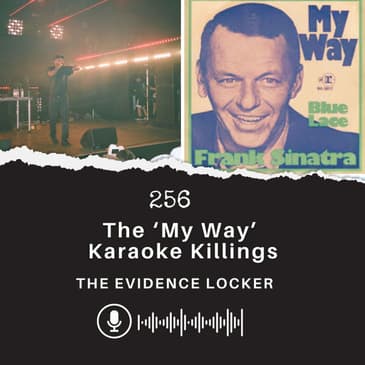
In 2007, 29-year-old Romy Baligula was enjoying a night out at a karaoke bar. Like many before him, he decided to take on the challenging task of singing Frank Sinatra’s “My Way.” As he belted out the lyrics, he was interrupted by Robilito Ortega, a security guard who insisted he was off-key and needed to stop.
Tempers flared and a heated argument ensued. Romy refused to back down, insisting he was singing it “his way.” The altercation escalated to the point where Ortega drew his gun and shot Baligula point blank, right there in the karaoke bar. Romy died on the spot. An off-duty police officer took Ortega into custody.
The shocking incident made headlines across the Philippines. People were stunned by the brutality of the murder and the absurdity of the argument that had led to it. But this was just the beginning. This is a story of violence, ego, and the ultimate price paid for singing a song ‘your way’.
You are listening to: The Evidence Locker.
Thanks for listening to our podcast. This episode is made possible by our sponsors—be sure to check them out for exclusive deals. For an ad-free experience, join us on Patreon, starting at just $2 a month, with 25% of proceeds supporting The Doe Network, helping to bring closure to international cold cases. Links are in the show notes.
Our episodes cover true crimes involving real people, and some content may be graphic in nature. Listener discretion is advised. We produce each episode with the utmost respect for the victims, their families, and loved ones.
To understand why “My Way” became so charged with danger in the Philippines, it helps to know the song’s own unlikely history. The melody began life as a 1967 French pop song called “Comme d’Habitude” — meaning “As Usual” — composed by Jacques Revaux and performed by French pop star Claude François. It was a melancholy number about a marriage dying quietly from routine. A modest hit in Europe, but hardly a global sensation.
Everything changed when Canadian singer-songwriter Paul Anka heard it on the radio while holidaying in the south of France. He flew to Paris, negotiated the rights for the nominal sum of one dollar, flew home, and waited for inspiration to strike.
It arrived at one o’clock in the morning. Anka sat down at an old IBM typewriter and asked himself one question: if Frank Sinatra were writing this, what would he say? Sinatra had been openly talking about retirement. He’d been performing since 1935 and was tired of it. Anka wrote through the night, finished at five in the morning, then called Sinatra at Caesar’s Palace in Nevada to tell him he had something special. Sinatra recorded the song on December 30, 1968, and it was released in early 1969.
It became one of his signature songs, spending 75 weeks inside the UK Top 40 — a record that still stands. Sinatra himself reportedly loathed it. His daughter Tina later revealed he found it:
“...self-serving and self-indulgent. He didn’t like it. That song stuck and he couldn’t get it off his shoe.”
In his later years, Sinatra described it as simply “a Paul Anka pop hit which became a kind of national anthem.” It is also worth noting that before Anka wrote his English version, a young David Bowie had attempted to adapt the same French melody. His version, titled “Even a Fool Learns to Love,” was never released. The world got Anka’s instead — and with it, a song that would eventually sit at the centre of one of the strangest series of killings in modern history.
The Philippines, a picturesque archipelago in Southeast Asia, is known for its breathtaking landscapes, rich culture, and its deep love for music. In Manila, karaoke — known locally as videoke — is practically a national sport. It is hard to find a street corner without a karaoke machine, and people from all walks of life belt out their favourite tunes with gusto.
Frank Sinatra’s “My Way” was a cultural phenomenon there. People sang it at birthdays, weddings, and funerals. It was the anthem of personal triumph — a declaration that a person had lived and survived on their own terms. But somewhere along the way, it became something else entirely.
To understand the killings, it also helps to understand what karaoke means in the Philippines. A videoke machine costs just a few pesos per song — around five Philippine pesos, or roughly eleven US cents, at the height of the killings in 2007, when many Filipinos were earning the equivalent of about two US dollars a day. For a lot of people, it was the most affordable entertainment available. Every barangay, the smallest administrative unit in the Philippines, was typically equipped with multiple karaoke bars, often staying open well past midnight. Karaoke was not a novelty. It was woven into the fabric of celebrations, gatherings, and everyday social life. Singing well was a point of pride. Singing badly was, in some circles, an embarrassment that could not be easily overlooked.
Between 2002 and 2018, Sinatra’s song was linked to at least a dozen deaths in the Philippines. The killings did not follow a single pattern. Some victims were shot for singing off-key. Others were killed for hogging the microphone. Some never even got to sing at all — they were killed simply for grabbing the mic when someone else had claimed “My Way” as theirs.
The earliest documented incident dates to 1998, in the province of Pangasinan, where a family dispute in a karaoke bar turned fatal after an argument over who would sing the song.
But the case that put the phenomenon on the map came in 2007. Romy Baligula, 29, was shot in the chest with a .38 calibre pistol by security guard Robilito Ortega, 43, at a karaoke bar in San Mateo, Rizal. Baligula had been singing “My Way” off-key and refused to stop when Ortega complained. Ortega was detained at the scene. Baligula died before help arrived.
In 2008, 60-year-old Antonio Belarmino was shot and killed in a karaoke bar in the same municipality, San Mateo, Rizal. Fellow patron Rolando Bayot shot him after taking exception to his performance of the song.
In 2009, 73-year-old retired policeman Rodolfo Gregorio was shot dead in a bar in the province of Cavite after singing “My Way” out of tune. The killer was never identified and has never been caught.
In August 2014, coworkers Sammy Dacutanan Jr. and Policardo Ricamara were out drinking and singing karaoke in Legazpi City, Albay. An argument broke out over who had the right to sing “My Way.” Back at their staffhouse afterward, Dacutanan confronted Ricamara and stabbed him to death. A third coworker was also wounded.
In November 2017, 23-year-old Anthony Mabansag was stabbed by his friend Arjhay Oliva in Navotas City. There had been a karaoke party at Anthony’s house that night. A fight broke out over who would get to sing “My Way,” but the other guests broke it up. An hour after everyone had left, Arjhay returned and settled the argument with three slashes to his friend’s neck.
A month later, in December 2017, barangay chairman Randy “Bong” Reyes, 46, was shot dead at a Christmas party in Tondo, Manila. Video footage broadcast by ABS-CBN showed Reyes dancing and joking around in a blond wig before deciding to sing “My Way” as the finale — despite his friends’ protests about the song’s grim reputation. He thought it would be the perfect ending to the night. As it turned out, it was his final curtain. Minutes after he finished singing, two masked men arrived on a motorcycle, called out his name, and shot him twice when he turned to look. Reyes died on the spot. A bystander who had been parking his tricycle and inadvertently blocked the killers’ escape route was also shot and critically injured. Police investigators said they were looking at drug-related motives, though Reyes’ family and friends maintained the killing was politically motivated. No arrests were made.
The last known incident on record occurred in June 2018, at a birthday party in Dipolog City, Zamboanga del Norte. Rolando Cañeso, 28, was about to sing “My Way” when his neighbour, 61-year-old Jose Bosmion Jr., grabbed the microphone from him. A fistfight broke out and the other guests separated them. When no one was watching, Cañeso produced a knife and stabbed Bosmion in the chest. Bosmion was declared dead on arrival at hospital. Cañeso fled but later surrendered to police.
After a string of deaths, bar owners across the Philippines began pulling “My Way” from their machines. The decision was part practical, part superstitious. A Rodolfo Gregorio — a 63-year-old Filipino barber, no relation to the retired policeman killed in Cavite — told the New York Times:
“I used to like ‘My Way,’ but after all the trouble, I stopped singing it. You can get killed.”
By 2007, the song had reportedly been removed from playlist machines not only in Manila, but in bars across Bangkok and Tokyo as well. The Philippine National Police issued warnings and launched public awareness campaigns urging people to refrain from singing “My Way” in public venues.
The phenomenon even caught the attention of Japanese rock band Kishidan, who released an uptempo cover of “My Way” as their 10th anniversary single. The promotional music video features the lead singer being shot multiple times while performing — a darkly comedic nod to the Filipino killings.
In 2018, a bill was filed in the Philippine Congress proposing a 10 p.m. curfew on all karaoke sessions, aimed at curbing alcohol-fuelled violence in entertainment venues.
But with so many iconic songs that are slaughtered in karaoke bars worldwide, why does this song strike a particular chord? The My Way Killings attracted the attention of journalists, psychologists, and pop culture academics who set out to understand what exactly it was about this one song that kept getting people killed.
A 2010 article in the New York Times, written by Norimitsu Onishi, brought the phenomenon to a global audience. Onishi argued the killings were likely a product of the Philippines’ broader culture of violence and drinking, rather than anything specific to the song itself. Not everyone agreed. Eric Alterman, a distinguished professor of journalism at CUNY, was sharply critical of the piece, noting it lacked verified witness accounts or police reports. He wrote:
“You can make up as much stuff as you want, as long as nobody in power has a reason to object.”
It was a fair challenge: the exact number of killings was never formally confirmed by Philippine police, and the phenomenon had taken on the quality of an urban legend as much as a documented crime pattern.
Roland B. Tolentino, a pop culture expert at the University of the Philippines Diliman, offered a measured take. He told the BBC:
“You’d get a lot of drunk men who would get into an argument over another person’s singing of ‘My Way,’ and some of these things do lead to very violent endings.”
He noted that the song’s “triumphalist” quality — the sense of a man declaring victory over life’s difficulties — had an aggravating effect on both the person singing it and those forced to listen. But he also pointed out that other songs just as popular in the Philippines had never led to murder.
Butch Albarracin, owner of Center for Pop, a Manila-based singing school, had a blunter view:
“The lyrics evoke feelings of pride and arrogance in the singer, as if you’re somebody when you’re really nobody. It covers up your failures. That’s why it leads to fights.”
Dr Mary Lacanlale, a Filipino-American ethnomusicologist, noted something else entirely. She argued that much of the international fascination with the My Way Killings was driven by the strangeness of Filipinos fighting and dying over an American song. The story, she suggested, would have attracted a fraction of the coverage it received if the song had been Filipino. The killings became, in part, a lens through which outsiders could view the Philippines as exotic and violent, rather than a serious look at the actual crimes.
The Philippines was shaped by more than three centuries of Spanish colonisation, followed by American rule from 1898 until independence in 1946. The American influence in particular left deep cultural roots — in language, music, and popular entertainment. Frank Sinatra and “My Way” arrived in that context as something aspirational. To sing it well was to claim a kind of dignity. To be ridiculed for singing it badly was, for some, an intolerable humiliation.
One verifiable fact that no analyst disputes: the Philippines had an estimated one million illegal firearms in circulation at the height of the killings. When pride, alcohol, and a loaded gun end up in the same room, the spark can be almost anything — a missed note, a grabbed microphone, a look. In that light, the My Way Killings are less a story about one song and more a story about what happens when a small act of public humiliation meets a culture where losing face carries genuine consequences, and where a weapon is rarely far from hand.
The My Way Killings were the most concentrated example of karaoke violence on record, but they were far from the only one. In August 2007, a karaoke singer in Seattle, Washington, was attacked by a woman who wanted him to stop singing Coldplay’s “Yellow.”
In March 2008, a man named Weenus Chumkamnerd in Thailand shot eight people dead, including his own brother-in-law, during a dispute that escalated from repeated karaoke renditions of John Denver’s “Take Me Home, Country Roads.” Chumkamnerd later told local media he had warned the group repeatedly about the noise before returning with a gun. No one in the group, he said, pleaded for their life. They were all too drunk.
In December 2008, a man at a Malaysian coffee shop was stabbed to death by fellow patrons after monopolising the karaoke microphone for too long.
In August 2012, a family gathering at a karaoke parlour in Xi’an, China, descended into tragedy when a four-year-old boy’s rendition of “My Way” sparked a family argument. One of the men present left for a nearby noodle shop and returned with a meat cleaver. He attacked two relatives, killing them both at the scene.
In July 2013, an American tourist was stabbed to death at a karaoke bar in Krabi, Thailand, after refusing to stop singing.
In 2017, a Vietnamese man murdered a fellow guest at a wedding after being mocked and booed off stage while singing karaoke.
In March 2022, American actor Ezra Miller was arrested and charged with disorderly conduct and harassment after a karaoke bar incident in Hawaii, reportedly becoming agitated and aggressive as other patrons began to sing.
These cases span continents and dozens of motivations. Karaoke — cheap, democratic, joyful by design — is also an activity that places people in a state of social exposure. To sing badly in public is to be vulnerable. To be laughed at or challenged while holding a microphone is, for some people, a humiliation too far. In countries with easy access to weapons and a culture of not backing down, the consequences can be fatal.
The Philippines gave this phenomenon a name and a mythology. But the underlying ingredients — alcohol, ego, a perceived insult and a weapon within reach — are not unique to any country, any song, or any particular Friday night. The My Way Killings were extreme. They were also, in a grim way, a very human story.
If you'd like to dive deeper into this case, check out the resources we used for this episode in the show notes.
Don’t forget to follow us on social media for more updates on today's case – you can find us on Facebook, Instagram, TikTok and X. We also have a channel on YouTube where you can watch more content.
If you enjoy what we do here at Evidence Locker, please subscribe on Apple Podcasts or wherever you're listening right now and consider leaving us a 5-star review.
This was The Evidence Locker. Thank you for listening!
©2026 Evidence Locker Podcast
All rights reserved. This podcast or any portion thereof may not be reproduced or used in any manner whatsoever without the express written permission of the publisher except for the use of brief quotations in a podcast review.