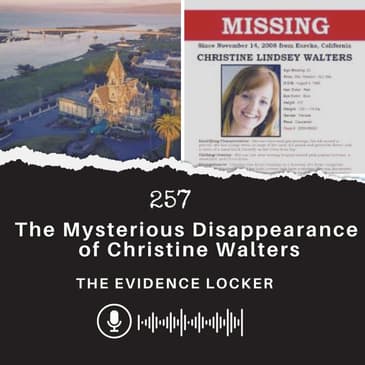
On the morning of November 12, 2008, a couple living on Tompkins Hill Road outside Arcata, California, opened their front door to find a young woman standing on their porch. She was naked. Her skin was lacerated from head to toe with deep briar scratches. She was trembling and could not give a coherent account of where she had come from or what had happened to her. What she could say, clearly and repeatedly, was this: someone was after her. Demons could hear her. They were going to find her wherever she went.
The homeowners called police. Officers took the young woman to St. Joseph's Hospital in Eureka. She was treated, discharged, and driven to a motel. She called her mother in Wisconsin, saying she was frightened and ready to come home.
Two days later, on the afternoon of November 14, she walked out of a copy centre on I Street in Eureka, wearing pyjamas and hospital-issue Crocs. She was carrying photocopied identification documents her mother had faxed from Wisconsin. Witnesses said she looked over her shoulder as she left. She then asked for directions to the DMV, roughly one mile away.
She was never seen again. More than sixteen years have passed and has never been found...
You are listening to: The Evidence Locker.
Thanks for listening to our podcast. This episode is made possible by our sponsors—be sure to check them out for exclusive deals. For an ad-free experience, join us on Patreon, starting at just $2 a month, with 25% of proceeds supporting The Doe Network, helping to bring closure to international cold cases. Links are in the show notes.
Our episodes cover true crimes involving real people, and some content may be graphic in nature. Listener discretion is advised. We produce each episode with the utmost respect for the victims, their families, and loved ones.
Christine Lindsey Walters was born on August 8, 1985, and grew up in Deerfield, Wisconsin, a small farming community of a few thousand people about twenty miles east of Madison. To the people who knew her there, she was hard to miss — not because she sought the spotlight, but because her warmth and her restless curiosity made her the kind of person people remembered. Her friend Katie Kloth later described her for the UW-Stevens Point student newspaper as someone who was…
"really outgoing; very nice person, very beautiful girl. She was always looking for adventure, and I think she always just wanted to keep traveling because she wanted to be a yoga instructor, and she didn't know where she'd fit in."
Christine enrolled at the University of Wisconsin–Stevens Point to study botany and ethnobotany — the scientific study of the relationships between plants and people. It was a discipline that fit her perfectly. She worked on an organic farm in Stevens Point. She taught Pilates and yoga in Deerfield and at Madison's Princeton Club and had been offered a similar teaching role in Stevens Point for the coming year. She moved through the world lightly, favouring natural foods and thrift store clothing, and she had long since stopped wearing makeup. Her UW-Stevens Point friend Toni Osiecki described her as someone who was in the middle of a period of real growth, saying:
“She was getting back in touch with herself."
Christine had recently ended a relationship, and those close to her said she seemed to be rediscovering her independence.
Before she left for her summer trip, she and her mother, Anita, decorated a bedroom together in the house Christine was going to share with friends when she returned in the fall.
In July 2008, Christine bought a round-trip ticket to Portland, Oregon. The plan was a three-week visit to a friend, then back to Wisconsin in time for the fall semester. Toward the end of her Portland stay, she called her parents and told them she wanted to extend the trip — she wanted to travel south to Northern California. They supported her decision, as she had always been independent and a little more time on the West Coast didn’t seem out of the ordinary.
Christine then made her way to Humboldt County. The county sits about 250 miles north of San Francisco, where the Coastal Redwood forests meet the Pacific. Its largest city, Eureka, has a population of roughly 25,000 and is lined with ornate Victorian houses. Seven and a half miles north lies Arcata, home to Humboldt State University and a counterculture community with deep roots in environmentalism, alternative spirituality, and communal living. For someone with Christine's interests and sensibilities, it must have felt like a natural habitat.
She fell in with people who described themselves as spiritual environmental activists, some living off the grid. She connected quickly and had a blast, attending music festivals and hanging out. A MySpace message she sent to Toni Osiecki in early October — the last Osiecki would receive from her — mentioned that Christine had attended a shamanic gathering. She apologised for being out of touch, explaining she had been off the grid for a while. Toni said:
“I can totally imagine her being completely content living day-to-day."
She also became a regular at a centre called Green Life Evolution, which operated from two locations — one in Eureka, and a second in Blue Lake, about sixteen miles northeast. The centre positioned itself around environmental consciousness and spiritual development. Christine stored her backpack there, left it in the care of the owner when she went for long walks in the Arcata Community Forest. She had come to feel at home there.
Around this time, phone calls home had grown less frequent and less settled. She was not working consistently, and she had begun asking her parents for money. Her father wired her one thousand dollars, but strangely, she left the account untouched. Anita Walters later told the Times-Standard:
"I believe she was too trusting of the people she met in California. She didn't know the people and didn't understand the culture out there."
On October 28, Anita called her daughter and asked her to come home, even temporarily. Christine said she wasn't ready. She told her mother she was on a "journey" and needed to follow her "path." It was the last time their calls felt normal.
On November 7, 2008, Christine participated in what investigators and her family's private investigator later confirmed was an ayahuasca tea ceremony. It involved approximately twenty participants and was led by a shaman named Tito Santana. The event was connected to the Green Life Evolution community.
Ayahuasca is a plant-based brew used in indigenous Amazonian spiritual traditions. It contains two active compounds: harmine, which is legal in the United States, and dimethyltryptamine — DMT — which is a Schedule I controlled substance under US federal law. The combination is what makes the drink pharmacologically and legally significant. Ingesting it causes vomiting, diarrhoea, and hallucinations that can last up to ten hours. The Charley Project notes that it has also been associated with "adverse reactions, including episodes of depression or mania, in some people who are predisposed to mental illness." This ceremony was illegal under US drug law.
According to people at Green Life Evolution, after the ceremony Christine rested with the other participants as expected. But on the evening of November 11 — four days after the ceremony — she left by herself. She had no bag. No shoes. No identification. She walked out into a dark November night in rural Northern California.
She surfaced the following morning, twenty miles away.
On the morning of November 12, the couple on Tompkins Hill Road found Christine on their porch. She was naked, cold, hungry, and deeply disoriented. The briar scratches across her body suggested she had moved through dense undergrowth for an extended period. The homeowner called police.
Officers took Christine to St. Joseph's Hospital in Eureka. She was treated for her physical injuries. Investigators attempted to interview her, but she would not or could not give a clear account of what had happened. She told them she had "walked a long way." She told them that demons could hear her, and that they were coming for her. She tested negative for drugs at that time.
Private investigator Chris Cook, later hired by the Walters family, recounted the police assessment at the time:
"We didn't think there was any evidence of drug use or mental illness. She was just really frightened."
On that basis, police did not detain her involuntarily. They drove her to the Red Lion Hotel on the 1900 block of 4th Street in Eureka. She had a room. She had a phone. And she called her mother.
Anita Walters later described those calls. Christine was paranoid and not making sense. She kept repeating that people were going to find her no matter where she went. But she was also clear about one thing: she wanted to come home.
The problem was identification. At some point in the preceding days, Christine had lost her wallet — her driver's licence, her cards, everything. Without documents, she couldn't fly. Anita agreed to fax copies of Christine's driver's licence and social security card to a copy centre in Eureka so Christine could go to the DMV, access her bank account, and organise a ticket home.
The plan was made. The escape route was in place. On the morning of November 14, 2008, Christine checked out of the Red Lion Hotel. At approximately
1:00 pm, she dropped her room keys at the front desk. She was wearing hospital-issue pink pyjama bottoms and Crocs – and that was it, literally the clothes on her back and nothing else.
At approximately
3:30 pm, she arrived at Copy Co. Printing on I Street in Eureka. The owner of the copy centre would later tell investigators that Christine appeared extremely nervous. She was looking over her shoulder. Her hair was dishevelled. She picked up the documents her mother had faxed — the photocopied identification she needed to get home — and held them tightly to her body, appearing to shield them from view as she moved through the shop. Surveillance confirmed the behaviour.
She asked staff for directions to the DMV. It was approximately one mile away. She left. She turned up the street. The last confirmed sightings place her near the Central Office building on I Street at around
2:45 to
3:00 pm — just before she arrived at the copy centre. After that: nothing. One mile of open street, broad daylight, a city of 25,000 people, and she vanished as completely as if she had stepped through a door that closed behind her.
Christine's family did not hear from her that evening. They waited. Then the day after, and the day after that. On November 17, Anita Walters reported her daughter missing to police. The Eureka Police Department took the initial report. On December 4, the case was transferred to the Humboldt County Sheriff's Office, where Detective Dan Paris became the lead investigator.
Paris — who was managing approximately fifteen active missing persons cases at the time — told reporters he was "particularly hopeful" about Christine's case and gave her "a better than 50-50 chance" of returning. He and private investigator Chris Cook were the two main figures working the case in those early months.
From the outset, the investigation encountered a structural obstacle that characterises missing persons cases in this part of California: the community's entrenched suspicion of law enforcement. Humboldt County sits within the Emerald Triangle — Humboldt, Trinity, and Mendocino counties — which is one of the largest cannabis-growing regions in the United States. The informal economy it sustains has historically drawn a transient population and fostered a culture where cooperation with police is inconsistent, to say the least. Those connected with Green Life Evolution and the ayahuasca ceremony proved particularly difficult to engage. One reported witness was a schoolteacher who became distressed at being questioned, reportedly fearing for their job. Whether all twenty ceremony participants were ever formally interviewed is not a matter of public record.
Tito Santana, the shaman who led the ceremony, later stated publicly that he had not learned of Christine's disappearance until early December 2008 — some two months after the fact — when a friend in Oregon called to tell him there was a rumour circulating about someone who had gone missing during "a ceremony in the woods" with him. He disputed that framing, denied that anyone had left his ceremony, and said he had attempted to contact the lead organiser of the Arcata event without success. Whether law enforcement formally interviewed him in the weeks immediately following November 14 is unclear.
In the meantime, Christine's belongings — including her money, her identification, and the large backpack she had borrowed from Toni Osiecki — turned up at the Green Life Evolution centre in Arcata. The centre's owner confirmed to investigators that Christine regularly left her backpack there while taking walks in the Arcata Community Forest. But the timing was unsettling: the $1,000 her father had wired sat untouched, and the identification documents she had gone to such lengths to retrieve were back at the centre, not with Christine.
A cadaver dog search at Cooper Gulch Park in Eureka and the marina area returned two reported hits. They did not lead to a discovery. In mid-2009, Eureka Police contacted Anita Walters to request a DNA sample from Christine — a limb had been turned in, and they needed to rule her out. It was not Christine. No explanation of whose remains they were has been made public.
There are things about this case that have never been satisfactorily explained.
The first is the gap between the ceremony on November 7 and Christine's appearance on the doorstep on the morning of November 12. That is four days, unaccounted for. She left the Green Life group on the evening of November 11, twenty miles from where she was found. In November, in Northern California, the nights are cold and dark. She arrived at Tompkins Hill Road naked and covered in briar scratches. She told investigators she had "walked a long way." What happened in those four days — and on that final night — is entirely unknown.
The second is the gap of two hours between when Christine left the Red Lion Hotel at
1:00 pm and when she arrived at the copy centre at
3:30 pm. The copy centre was not a long walk from the hotel. Where she was in that interval has never been established.
The third, and the one that sits most heavily, is the final mile. In pyjamas and Crocs, visibly distressed, in a city of 25,000 people, in the middle of the afternoon. Someone on that street saw Christine Walters. Someone knows what happened on that walk. Whoever that person is has not come forward.
Foul play has never been ruled out. Nor has the possibility — raised carefully and without blame by some investigators — that Christine, in a profound state of psychological distress, made choices in those final hours that took her somewhere she could not come back from. The terrain of Humboldt County — its dense redwood forests, its riverbanks, its miles of unmapped wilderness — does not give up its dead easily.
Thomas Lauth of Lauth Investigations International, who later reviewed the case, described it as one of the most baffling in his twenty years of experience.
Christine Walters is one of five women who have come to be known collectively as the Humboldt Five — young women with broadly similar profiles who vanished or were murdered in Humboldt County across a fifteen-year span. Jennifer Wilmer disappeared in Trinity County in September 1993. Karen Mitchell, sixteen years old, vanished from downtown Eureka on November 25, 1997. Sheila Franks went missing in February 2014. Danielle Bertolini, also 23, was murdered in 2014; her skull was recovered from a riverbed in 2015, and her death was ruled a homicide.
There is no confirmed connection between Christine's disappearance and the other cases. They occurred across different years, under different circumstances, and have been investigated separately. What links them, beyond geography, is the way coverage of their cases has been shaped — or has failed to materialise — because of where and how these women were living when they disappeared.
Christine Walters was not reckless. She was a botany student and a yoga teacher who had worked on an organic farm and decorated a bedroom with her mother before leaving on what was supposed to be a three-week trip. Her interest in spirituality, in plant medicine, in alternative ways of living — these were genuine expressions of who she was, and not a death warrant. She was a person navigating an unfamiliar world with more trust than caution. That is not a character flaw. It is simply being young.
In a 2013 interview with the Times-Standard, Anita Walters spoke about what life has been like since November 2008:
"Since then our life has been a nightmare of endless thoughts as to what could have possibly happened to her. It's just very, very sad and heartbreaking to have raised Christine for 23 years, only to have her disappear without a clue."
She added:
"We want Christine to know we love her dearly and miss her very much, and we pray every day for an answer as to what happened to her. Someone must have seen her and certainly, there is one person that has the answer, so please help us."
Christine's family has maintained a Facebook page — Help Find Christine Lindsey Walters — since her disappearance. Every year on August 8, a birthday post goes up. She would be 40 years old today.
Christine Lindsey Walters is classified as Endangered Missing in the National Missing and Unidentified Persons System — NamUs — under Case Number MP5477. She is also listed with the California Department of Justice and the Charley Project.
She is described as a white female, between five feet two and five feet four inches tall, weighing between 100 and 115 pounds, with strawberry-blonde hair and blue eyes. She has a small black butterfly tattooed on her lower front hip and a large purple and green iris flower tattooed on the nape of her neck. She may use the names Airy Meadow, Airystar, Meadow, or Star.
If you have any information about the disappearance of Christine Walters, please contact the Humboldt County Sheriff's Office on 707-445-7251, or the Eureka Police Department on 707-441-4060.
If you'd like to dive deeper into this case, check out the resources we used for this episode in the show notes.
Don’t forget to follow us on social media for more updates on today's case – you can find us on Facebook, Instagram, TikTok and X. We also have a channel on YouTube where you can watch more content.
If you enjoy what we do here at Evidence Locker, please subscribe on Apple Podcasts or wherever you're listening right now and consider leaving us a 5-star review.
This was The Evidence Locker. Thank you for listening!
©2026 Evidence Locker Podcast
All rights reserved. This podcast or any portion thereof may not be reproduced or used in any manner whatsoever without the express written permission of the publisher except for the use of brief quotations in a podcast review.