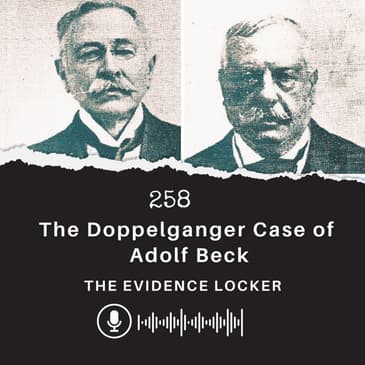
It was a cold winter’s day in London in 1896, and inside a busy courtroom, a quiet, well-dressed man stood in the dock, listening as one witness after another stepped forward to identify him. The women spoke with certainty. They described how he had approached them in public places, how he had gained their trust with polite conversation and convincing stories, and how, in the end, they had handed over money and jewellery, believing they were helping a respectable gentleman in temporary need.
Each account was slightly different, but the man they described was always the same. And as each witness pointed towards the dock, their confidence seemed to grow. The accused, a Swedish clerk by the name of Adolf Beck, listened in disbelief. He had never met these women before. He had never asked them for money, never taken their possessions, and never used the name by which they claimed to know him. Yet despite his protests, the case against him appeared straightforward. There were no complicated forensic questions, no intricate timelines to unravel. Instead, the prosecution relied almost entirely on something far more persuasive in the eyes of a jury — human recognition. Multiple witnesses, all certain they were looking at the same man.
In a time before fingerprinting and modern investigative methods were widely used in policing, that kind of certainty carried weight. Beck found himself in an impossible position. The more he insisted on his innocence, the more it seemed that he was simply refusing to admit what so many others believed to be obvious. Because how could so many people be mistaken?
What no one in that courtroom yet realised was that somewhere in London, another man was walking free — a man who had committed the crimes in question, and who bore a striking resemblance to the one now standing trial. In the years that followed, the case of Adolf Beck would expose a troubling flaw in the justice system, one rooted not in malice, but in the limits of human perception.
It would raise questions about memory, identity, and the dangerous confidence with which people believe they recognise a face. And long before science could offer clear answers, such cases were often explained in a very different way: As the work of a double. A second self. A doppelganger.
You are listening to: The Evidence Locker.
Thanks for listening to our podcast. This episode is made possible by our sponsors—be sure to check them out for exclusive deals. For an ad-free experience, join us on Patreon, starting at just $2 a month, with 25% of proceeds supporting The Doe Network, helping to bring closure to international cold cases. Links are in the show notes.
Our episodes cover true crimes involving real people, and some content may be graphic in nature. Listener discretion is advised. We produce each episode with the utmost respect for the victims, their families, and loved ones.
Adolf Beck was born in 1841 in Sweden, into a respectable middle-class family. His upbringing was stable and conventional, shaped by structure, education and a strong sense of personal discipline. There was nothing in his early years that hinted at the kind of notoriety his name would later attract.
As a young man, Beck trained in clerical work and found his place in the shipping industry, a profession that required careful attention to detail and a high degree of trustworthiness. He spent many years working across Europe, building a quiet but steady career. By all accounts, he was reliable and methodical, well suited to the administrative demands of his work.
At some point later in life, Beck made his way to England and eventually settled in London. By then, he was in his fifties. The city, with its constant movement of people and goods, offered opportunities for someone with his experience. He secured employment as a shipping clerk and established a modest, routine-driven life.
Those who knew him described a reserved and polite man. He dressed neatly, conducted himself with a certain formality, and spoke fluent English, though traces of his foreign background remained. In a city as large and diverse as London, he was just one of many individuals going about their daily lives.
Beck did not appear to have an extensive social circle. He kept to himself, focused on his work, and maintained a quiet existence. There were no reports of erratic behaviour, no known disputes, and no indication that he had ever been involved in anything even remotely criminal. If anything, his life was defined by its predictability.
At the same time, however, there was another man operating in London who lived a very different kind of life. This individual moved through respectable social circles with ease, presenting himself as trustworthy and well-connected. He approached women, often those who were financially comfortable, and gained their confidence through charm and persuasion. Once that trust had been established, he would exploit it, convincing them to hand over money or valuables under false pretences. By the time his victims realised what had happened, he had disappeared.
Police were aware that such a man was operating in the city. Complaints had been made, statements taken, and a vague description began to take shape. He was said to be well-dressed, composed, and convincing. Someone who could pass, at a glance, as entirely respectable. What investigators did not yet understand was just how dangerous such a description could be. Because it did not describe just one man. It described a type. And in a city the size of London, that type could be found more than once.
In the months leading up to Adolf Beck’s arrest, police in London began receiving a number of complaints from women who believed they had been deceived by the same man. Although each account differed in detail, the overall pattern was consistent. The man they described was well-dressed, courteous, and carried himself with quiet confidence. He approached his victims in public places, struck up polite conversation, and gradually gained their trust. There was nothing about his behaviour that caused immediate alarm. On the contrary, he appeared to be respectable, someone who belonged in the social circles he moved through.
Once that trust had been established, he would begin to make requests. In some cases, he asked for financial assistance, presenting his situation as temporary and credible. In others, he persuaded his victims to part with jewellery, often under the impression that the items would be returned. By the time the women realised they had been deceived, the man had disappeared without a trace.
As more complaints were made, investigators began to suspect that a single individual was responsible for these offences. Descriptions were taken from the victims and compared, and while there were minor differences, the general impression of the suspect remained the same: a man of respectable appearance, well-spoken, and convincing enough to gain the confidence of strangers.
At this point, the investigation took a decisive turn. Police began to consider whether the offender might be linked to a man who had previously operated under the name “John Smith,” a known fraudster who had used similar methods in earlier cases. Adolf Beck, whose background included time spent abroad and who bore a resemblance to the general description provided, came to their attention.
Once he was identified as a possible suspect, the direction of the investigation narrowed.
What followed would shape the entire case.
Several of the women who had reported being defrauded were asked to identify the man responsible, both during the investigation and later in court. One by one, they indicated that Beck was the person who had approached them. Some were emphatic in their identification, expressing little to no doubt. Others appeared less certain, but still believed him to be the same man.
There was no physical evidence linking Beck to the crimes. None of the stolen items were found in his possession, and there were no independent witnesses placing him at the scenes beyond the testimony of those who believed they recognised him. Despite this, the consistency of the identifications was seen as compelling.
The case proceeded to court, where the prosecution relied almost entirely on the accounts of the victims. Their testimonies were presented as credible and mutually reinforcing, creating the impression of a clear and coherent case against the accused. Beck maintained his innocence throughout, stating that he had never met the women and had no involvement in the offences. However, in the absence of alternative explanations, and with multiple witnesses identifying him, the jury was persuaded.
Adolf Beck was convicted and sent to prison.
At that point, the matter appeared to have been resolved. A man had been identified, tried, and punished for a series of crimes. Yet the foundation of the case rested on recognition alone, and beyond the certainty expressed in court, there remained no material evidence to confirm that the right person had been held accountable.
At the time of Adolf Beck’s conviction, the investigation was considered complete. The police had a suspect, the courts had secured a guilty verdict, and the case was, for all practical purposes, closed. Beck was sent to prison, where he continued to maintain that a mistake had been made. He insisted that he had never met the women who testified against him and that he had no involvement in the offences. His protests, however, carried little weight against the certainty expressed during the trial. From the perspective of the authorities, there was no reason to revisit the case.
After serving several years of his sentence, Beck was eventually released. His conviction had not been overturned, but he was free to return to civilian life. By then, however, his reputation had been irreparably damaged. He was known as a convicted fraudster, and whatever quiet anonymity he once had was gone.
For a time, it seemed as though the matter had been left behind.
Then, in 1904, reports began to surface of a man committing offences that closely resembled those for which Beck had been convicted. The pattern was familiar. A well-dressed individual approached women, gained their trust, and persuaded them to part with money or valuables under false pretences. As before, the man disappeared before the deception was fully realised.
Police began investigating these new complaints, and eventually, a suspect was identified and arrested.
The man’s name was William Thomas, a known fraudster with a history of similar offences.
When witnesses were brought in to identify him, the response was immediate. Several of the women who had recently been defrauded recognised Thomas as the man responsible. What followed, however, was even more significant. Some of the original victims — the same women who had previously identified Adolf Beck — were also shown this new suspect. Some identified William Thomas. Others were unsure. In some cases, the same witnesses who had once spoken with confidence now appeared less certain than before.
This development raised serious questions about the earlier conviction. If the same witnesses could confidently identify two different men as the person who had deceived them, then the reliability of their testimony came into doubt.
Further investigation revealed that Thomas had a history of similar offences and had been operating in a manner consistent with the earlier crimes. His methods closely matched the pattern described in both sets of complaints, suggesting that he may have been responsible not only for the recent incidents, but also for those attributed to Beck years earlier.
As the case against Thomas developed, the similarities between the two men became more apparent. They shared a general resemblance in appearance and manner, enough to explain how one could be mistaken for the other under certain circumstances.
The implications were significant. If William Thomas was indeed the man responsible for the earlier frauds, then Adolf Beck had been convicted and imprisoned for crimes he did not commit. The matter could no longer be ignored. Public concern grew, and questions were raised about how such a conviction had been secured in the absence of material evidence.
In response, the case was brought back under official scrutiny, and a formal inquiry was established to examine the circumstances surrounding Beck’s conviction.
What had once appeared to be a straightforward investigation was now exposed as deeply flawed, built on identifications that could no longer be considered reliable. For Beck, this marked the beginning of a long-awaited reconsideration of his case. For the justice system, it highlighted a critical weakness — the extent to which certainty, when based solely on human recognition, could lead to a profound miscarriage of justice.
Cases like that of Adolf Beck highlight a fundamental problem in criminal investigations: the reliability of human perception. When people are certain they recognise a face, that certainty can be persuasive, even when it is misplaced.
Long before modern psychology began to examine the limits of memory and identification, there were stories that attempted to explain such phenomena in very different terms. One of the most widely reported — though unverified — accounts dates back to the mid-19th century and centres around a French schoolteacher named Emilie Sagée.
Sagée was employed at a girls’ boarding school in what is now Latvia. By all accounts, she was an ordinary woman and a competent teacher, but her time at the school became the subject of one of the most unusual and often repeated accounts of duplication. According to reports recorded at the time, Sagée was said to have been seen, on multiple occasions, in two places at once.
In one instance, while she was writing on a blackboard in full view of her class, a second figure, identical in appearance, was reported to have appeared beside her, mirroring her movements. The students later claimed that while Sagée continued teaching, the double stood silently, copying her actions without interacting with the surroundings. On another occasion, Sagée was reportedly working in the garden, visible from the classroom windows, when a second version of her was seen inside the room, sitting quietly at her desk. When two students approached this figure, they later claimed they were able to pass their hands through it, as though it lacked physical substance.
Over time, these accounts became more widely circulated, and concern was said to have spread among the pupils. Parents reportedly withdrew their children from the school, and Sagée eventually lost her position.
There was no clear explanation for what had been described. Some believed it to be a form of shared suggestion or misinterpretation. Others saw it as something more mysterious — a manifestation of what was often referred to as a “double”.
The idea of a doppelganger — a second self, identical in appearance — has appeared in folklore across many cultures. Traditionally, such an apparition was considered an omen, sometimes associated with misfortune or even death.
In more modern terms, similar experiences have been linked to neurological phenomena, where individuals perceive a duplicate of themselves or others due to disruptions in the brain’s processing of identity and spatial awareness. These explanations, however, do not fully account for accounts involving multiple witnesses describing the same event.
While the case of Emilie Sagée remains anecdotal and unverified, it reflects a long-standing fascination with the idea that identity is not always as fixed or singular as it appears. In the case of Adolf Beck, there was no suggestion of anything supernatural. The explanation, as it would emerge, was far more grounded in reality. And yet, the outcome was no less unsettling. Because in his case, the “double” was real.
Following the arrest of William Thomas, the case that had once seemed resolved was brought back into focus. The similarities between the offences attributed to Thomas and those for which Adolf Beck had been convicted were too significant to ignore, and questions surrounding the earlier trial began to surface with increasing urgency.
Thomas was charged in connection with the more recent frauds, and as proceedings moved forward, attention turned to whether he could also be responsible for the earlier crimes. His methods, his manner, and the circumstances described by the victims closely aligned with the pattern established years before.
Witness testimony once again played a central role. Several of the women who had identified Beck were asked to consider Thomas. Some recognised him as the man who had deceived them, while others expressed uncertainty, having previously been convinced of Beck’s guilt. The inconsistency in these identifications highlighted the difficulty of relying on memory alone, particularly when significant time had passed.
As the case developed, it became increasingly clear that Beck’s original conviction could not stand without scrutiny. The absence of physical evidence, combined with the emergence of a viable alternative suspect, cast serious doubt on the integrity of the earlier proceedings.
Authorities were compelled to revisit Beck’s case.
A formal inquiry examined the evidence and the circumstances of the original trial, allowing for the case to be reassessed in light of the developments surrounding William Thomas. This time, the focus extended beyond witness identification. Greater weight was given to the lack of corroborating evidence in the original case, as well as to the possibility that two men of similar appearance had been mistaken for one another.
During the renewed legal proceedings, Beck’s defence was able to present a clearer argument: that he had been wrongly identified and that the crimes had likely been committed by another individual operating in the same manner. The prosecution, which had previously relied heavily on the certainty of the witnesses, now faced the challenge of reconciling conflicting identifications.
In this context, reasonable doubt emerged where there had previously been confidence.
The court ultimately found that the evidence against Beck could not be sustained. His conviction was quashed, and he was formally pardoned.
For Beck, the decision represented a long-overdue recognition of the injustice he had endured. He had spent years imprisoned for crimes he did not commit, his life and reputation irrevocably altered by a case built on mistaken identity. He was later awarded financial compensation, an acknowledgment, in part, of the harm that had been done and the failure of the system that had convicted him.
The outcome also had broader implications. The case exposed significant weaknesses in the investigative and judicial processes of the time, particularly the reliance on eyewitness testimony without supporting evidence.
In the years that followed, the Beck case became a point of reference in discussions about legal reform. It contributed to the growing recognition that more reliable methods of identification were needed, helping to accelerate the adoption of fingerprinting as a standard investigative tool.
While the court’s decision brought a measure of resolution to the legal proceedings, it could not undo the years Beck had lost. Nor could it fully address the question that remained at the heart of the case — how it had been possible for so many people to be so certain, and yet so mistaken.
If you'd like to dive deeper into this case, check out the resources we used for this episode in the show notes.
Don’t forget to follow us on social media for more updates on today's case – you can find us on Facebook, Instagram, TikTok and X. We also have a channel on YouTube where you can watch more content.
If you enjoy what we do here at Evidence Locker, please subscribe on Apple Podcasts or wherever you're listening right now and consider leaving us a 5-star review.
This was The Evidence Locker. Thank you for listening!
©2026 Evidence Locker Podcast
All rights reserved. This podcast or any portion thereof may not be reproduced or used in any manner whatsoever without the express written permission of the publisher except for the use of brief quotations in a podcast review.