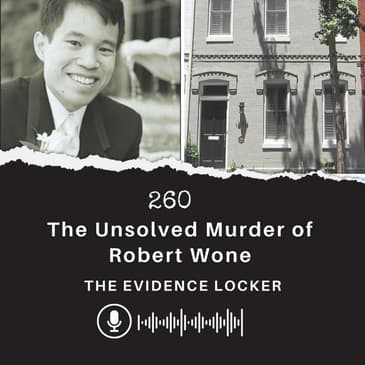
The last words Robert Wone ever said to his wife were "I love you."
It was
9:30 on the evening of Wednesday, August 2nd, 2006. Robert had called Kathy from his cell phone to let her know he was heading back to his new office on M Street in downtown Washington D.C. He was only a month into his exciting new role as general counsel for Radio Free Asia, and he wanted to introduce himself to the night-shift staff — the radio journalists who broadcast into China, North Korea, and beyond. It was the kind of thoughtful gesture that defined him.
Rather than make the long trip home to Oakton, Virginia late at night on the Metro, Robert had arranged days earlier to stay over with an old friend who lived just one mile from the office. It made practical sense. It was logical. It was safe.
But, by
12:24 in the morning, 32-year-old Robert Eric Wone was dead. He had been stabbed three times in the chest. And the questions that immediately surrounded his death have never been answered — not fully, not honestly, and perhaps, not ever.
What happened inside the townhouse at 1509 Swann Street Northwest in Washington's Dupont Circle neighbourhood on that warm August night remains one of the most confounding unsolved murders in the history of the American capital. This is the story of Robert Wone.
You are listening to: The Evidence Locker.
Thanks for listening to our podcast. This episode is made possible by our sponsors—be sure to check them out for exclusive deals. For an ad-free experience, join us on Patreon, starting at just $2 a month, with 25% of proceeds supporting The Doe Network, helping to bring closure to international cold cases. Links are in the show notes.
Our episodes cover true crimes involving real people, and some content may be graphic in nature. Listener discretion is advised. We produce each episode with the utmost respect for the victims, their families, and loved ones.
Robert Eric Wone was born on June 1st, 1974, and raised in a family that valued service, scholarship, and community. He enrolled at the College of William and Mary in Virginia in the early 1990s, and from the moment he arrived on campus, he made an impression.
He was a Monroe Scholar — an honour reserved for the university's most academically gifted incoming students. He served as a president's aide and a campus tour guide. He was inducted into Omicron Delta Kappa, the national leadership honour society, and the Golden Key International Honour Society. At his 1996 commencement, he was one of only two students awarded the Algernon Sydney Sullivan Award — given to those who demonstrate, in the words of the foundation, exceptional "heart, mind, and helpfulness to others."
Sam Sadler, who served as the university's vice president for student affairs and became a personal friend of Robert's, would later say that he was…
"…the kind of person who could have been elected to any office on campus, but he always chose to work from behind the scenes. He was constantly teaching me how to be a friend."
It was at William and Mary that Robert first met Joseph Price. Price was three years his senior and became something of a mentor figure to the younger student — he had given Robert and his parents their very first tour of the campus. The two shared a passion for politics and student government, and forged what, by all appearances, was a lasting friendship.
Robert went on to earn his Juris Doctor, with honours, from the University of Pennsylvania Law School. He clerked for Judge Raymond A. Jackson of the Federal District Court for the Eastern District of Virginia, then spent six years as a commercial real estate attorney at Covington and Burling, one of Washington's most prestigious law firms. During that time, he gave back, serving pro bono as general counsel for the Organization of Chinese Americans.
In January 2002, at a legal conference, Robert met Katherine Yu (Kathy) the daughter of Korean immigrants who had grown up in Chicago. Their connection was immediate. Within a year, he proposed. They married on June 7th, 2003, and settled into a home in Oakton, Virginia. By the summer of 2006, Kathy later recalled, they had careers they loved, friends who cared, and bright futures ahead.
On June 30th, 2006 — about a month before his death — Robert left Covington and Burling to take the role he had always wanted: general counsel for Radio Free Asia, an international broadcaster funded by the United States Government to provide uncensored news to audiences living under authoritarian regimes. It was meaningful work. It was exactly where Robert Wone wanted to be.
Meanwhile, his college friend, Joe Price was making waves of his own. Since his William and Mary days, Joe had become a prominent attorney with Arent Fox, a high-powered national law firm. He was active in LGBT advocacy groups, and had served as president of the Gay and Lesbian Alumni Association of the University of Virginia after completing his law degree there. By 2006, he was a recognised figure in Washington's progressive legal circles.
He lived in the heart of Washington's Dupont Circle neighbourhood — a vibrant, historically significant area that had become a centre of the city's gay community. The Victorian row house was owned by Joe and his partner Victor Zaborsky, and they shared the property with a third man, Dylan Ward.
Joe’s partner Victor worked in marketing. Dylan Ward, who occupied the basement of the home, was a massage therapist. The three men were in a polyamorous relationship but kept this fact to themselves.
Joe and Robert had maintained their friendship since university and Kathy knew Joe well. Joe’s house was the obvious place to crash when working in DC. On the night of August 2nd, Robert arrived at 1509 Swann Street at approximately
10:30 in the evening. His hosts later told investigators that after his arrival, Robert took a shower and retired to the second-floor guest room, which contained a pull-out sofa bed. The arrangement was simple and unremarkable. Robert was tired. He had a full day ahead of him.
Sometime between
11:00 and
11:30 in the evening, a neighbour reported hearing a scream coming from the direction of the house — a detail that would later be attributed to Victor Zaborsky. At
11:49 PM, Victor called 911. He was crying, and frantic.
"We had someone — in our house, evidently, and they stabbed somebody."
Paramedics arrived within five minutes. Police from the Metropolitan Police Department followed shortly after. Robert was transported to George Washington University Hospital, where he was pronounced dead at
12:24 in the morning on August 3rd. He had been stabbed three times — in the chest and abdomen.
Joe called Kathy to tell her that something had happened. He told her Robert had been stabbed in the back. Kathy and Robert's family rushed to the hospital, expecting to find him in critical condition. When they arrived, Robert was already gone. And — as Kathy would later note with quiet devastation — he had not been stabbed in the back at all. He had been stabbed in the chest and abdomen. It was, perhaps, a small detail. But it was the first of many discrepancies.
Bryan Waid, the lead detective assigned to the case, arrived at Swann Street in the early hours of August 3rd. What he found stopped him cold. Robert Wone was lying on the pull-out sofa bed, flat on his back. His body was arranged — almost composed. His grey t-shirt was back on. The bed linens had been neatly drawn around him. A first responder who arrived at the scene described it as though Robert had been "showered, redressed, and placed in the bed." And there was almost no blood. Detective Waid would later recall:
"Two bloodstains on a sheet and no other blood anywhere. You don't just take three to the chest and lay there and die."
A man stabbed three times in the chest and abdomen should have bled significantly. The near-absence of blood in the guest room — and indeed throughout the house — was, to an experienced homicide detective, deeply wrong. On a bedside stand, investigators found a knife. It had blood on it — but it was not the blood Robert had bled where he lay. When the knife was examined, forensic analysts found white fibres on the blade consistent with a towel found nearby. The evidence suggested the knife had been smeared with blood and placed near the body after the fact. The knife's blade shape did not match Robert's wounds. Investigators concluded it was not the murder weapon.
From a knife block in Dylan Ward's room in the basement, a knife was missing. The empty slot was consistent with the shape of the wounds on Robert's body. That knife has never been found.
When police arrived at 1509 Swann Street, all three housemates — Joe, Victor, and Dylan — were dressed in white terrycloth bathrobes. Their hair was damp. Detective Waid noted that their appearance suggested they had recently showered. One investigative consultant later described them as looking as though they had "just stepped out of a good executive steam." The three men provided initial statements without attorneys present, and those interviews were later shown at trial.
Joe told investigators that when he had gone to check on Robert, he found the knife on his chest and moved it to the bedside table. It was, on its face, an extraordinary claim — that a lawyer who had just discovered his friend stabbed to death picked up the potential murder weapon and relocated it before calling for help.
The three men's collective account was that they had heard "grunts" or sounds coming from the guest room, went to investigate, and found Robert already fatally wounded. They believed, they said, that an intruder had entered the house. There was no evidence of forced entry. Nothing had been taken.
When asked by detectives whether he had ever been attracted to Robert, Joe replied — and this is documented in police records:
"I don't have any doubts Robert was, you know, is straight as the day is long."
It is a curious thing to say, in an interview about a murdered friend. And ultimately did not answer the question.
The findings from Robert's autopsy deepened the mystery considerably — and raised questions that have never been satisfactorily resolved. The three stab wounds to Robert's chest and abdomen were, in the forensic assessment, surgically precise. There were no defensive wounds on Robert's hands or arms. His body showed no signs that he had struggled, moved, or attempted to resist. For the wounds to have been inflicted with such precision, the medical evidence suggested, the victim must have been lying completely still at the moment of each blow.
The question of how Robert came to be so immobile led investigators to examine another disturbing possibility: that he had been incapacitated before he was killed. Investigators found puncture marks on Robert's body that were not consistent with the stabbing. There was also physical evidence that he had been sexually assaulted.
Toxicology testing conducted as part of the autopsy did not detect any paralytic or sedative drugs in Robert's system. However, prosecutors and investigators noted that certain anaesthetic compounds — particularly those used in medical or surgical settings — metabolise rapidly and may dissipate from the body before standard toxicology panels can detect them. The absence of a positive finding was not, in the view of investigators, confirmation that no drug had been used. It was, at best, inconclusive.
The BDSM implements found in the home — items capable of restraining a person — were examined by investigators. None could be forensically linked to Robert Wone. But their presence contributed to investigators' broader picture of the household and what might have occurred that night.
In the immediate aftermath of the murder, investigators moved quickly. The Metropolitan Police Department sealed the townhouse and spent weeks processing the scene. The three housemates were considered persons of interest from very early in the investigation. And yet, for more than two years, no charges were filed. The delay was, in part, a consequence of evidentiary difficulty. The circumstantial evidence was substantial. The physical evidence pointed clearly to staging. But the threshold for a murder charge — proof beyond a reasonable doubt — is high, and prosecutors were not yet confident they could meet it.
In the meantime, four men who lived in the Dupont Circle neighbourhood — who had followed the case from the beginning — created a blog: WhoMurderedRobertWone.com. Over the years that followed, the site generated more than 45,000 reader comments across nearly 600 posts, and more than two million page views. It became an extraordinary document of community investment in a case that the formal justice system seemed unable to resolve. One of the blog's editors, David Greer, told the Washington Blade that the blog would continue for as long as justice remained denied.
In September 2008 — more than two years after Robert's death — Joe Price, Victor Zaborsky, and Dylan Ward were indicted on charges of obstruction of justice, conspiracy to obstruct justice, and evidence tampering. The arrest affidavit, which became public at the time of the indictment, stunned Washington's legal and community circles.
The criminal trial started in May 2010 before Judge Lynn Leibovitz of the District of Columbia Superior Court. In a bench trial, the judge alone would weigh the evidence and deliver the verdict – there would be no jury.
Prosecutors argued that the three men had collectively staged the crime scene: placing a false weapon, cleaning Robert's body, re-dressing him, and arranging the bedding — all in an effort to mislead investigators and conceal what had truly happened. They did not, importantly, charge any of the men with murder. The prosecution presented no direct theory of who had actually killed Robert Wone. This limitation significantly constrained the strength of their case.
In June 2010, Judge Leibovitz acquitted all three defendants. In her ruling, she did not declare the men innocent. Her finding was explicit and careful: she stated that she believed the three men knew more than they had disclosed, but that the prosecution had not proven their guilt beyond the required standard. It was an acquittal by standard of proof, not an exoneration by finding of innocence. The murder of Robert Eric Wone remais officially unsolved. No one has ever been charged with it.
In the years following the criminal acquittal, Kathy Wone pursued accountability through the civil courts. A wrongful death lawsuit, filed against Price, Zaborsky, and Ward, alleged that they bore responsibility for her husband's death. Civil proceedings operate under a different and lower standard of proof than criminal trials — the balance of probabilities rather than beyond reasonable doubt — and so it offered a different avenue for justice.
In August 2011, the civil suit was settled. The terms were not disclosed publicly. Kathy Wone chose not to elaborate extensively on the settlement, but she did speak to the Washington Post. Her words were among the most quietly devastating of the entire case.
"I am moving on. I want to spend the next forty years of my life focusing on good. They can rot from the inside out from all the secrets they chose to keep. That's their choice. I chose to move on."
In October 2011, at William and Mary's homecoming weekend, family and friends gathered on Barksdale Field to dedicate two benches and two Chinese pistache trees in Robert's memory. The plaques installed at the site read:
"Rest awhile and enjoy the wonderful world around you."
Kathy attended. She said it was her first visit to campus since 2006, that it had been too painful to return before. She wrote to friends afterward that it had been "one of my happiest days since Robert's tragic death."
Robert's legacy also lives on through a number of memorials and scholarships established in his name, including the Virginia Department of Social Services' Robert E. Wone Award for Exemplary Service, and the annual Robert E. Wone Judicial Clerkship and Internship Conference, which rotates among Washington D.C. area law schools including Georgetown, American University, and Howard University.
Among the more troubling threads in this investigation is the question of who else might have been involved. Investigators also looked into Joe Price's younger brother, Michael, who was known to police for previous incidents. Three months after Robert's murder, Joe’s townhouse was burglarised — and Michael Price was subsequently identified as one of the perpetrators. Charges were dropped, but investigators noted a further detail: on the night of August 2nd, 2006, Michael missed a scheduled class at Montgomery College with no explanation. Whether this is a significant coincidence or a meaningful lead remains unresolved.
The case file at the Metropolitan Police Department has never been formally closed. There is no statute of limitations on murder in the District of Columbia. The investigation, in theory, continues.
Robert Wone was, by every account of those who knew him, a man who lived for others. He sought greatness in anonymity — his own phrase, written as a student to an old university president who had inspired him. He chose public service over private gain. He was a devoted husband, a generous friend, and a careful, intelligent man. He called his wife to say "I love you" at
9:30 on the last evening of his life. He deserved better than what happened to him inside that townhouse. He deserved, at the very minimum, the truth.
The three men who were present at 1509 Swann Street on the night of August 2nd, 2006 know more than has ever been said in a courtroom. Judge Leibovitz said as much. What they know, and what truly happened to Robert Eric Wone in those seventy-nine minutes between his arrival and the 911 call, has never been fully told. In an address at a memorial service for Robert, then-Attorney General Eric Holder said:
"As despicable as that crime was and is, as big a tragedy as that is, it is compounded by the fact that Robert's killer has not been brought to justice. Washington, D.C., is a great city, and in this case our city has not lived up to its greatness — in fact, none of us has."
Robert Wone deserved better. Kathy deserved better. And anyone who believes that a good man's death demands the truth — not just a settlement, not just an acquittal, but the actual truth — is still waiting.
If you'd like to dive deeper into this case, check out the resources we used for this episode in the show notes.
Don’t forget to follow us on social media for more updates on today's case – you can find us on Facebook, Instagram, TikTok and X. We also have a channel on YouTube where you can watch more content.
If you enjoy what we do here at Evidence Locker, please subscribe on Apple Podcasts or wherever you're listening right now and consider leaving us a 5-star review.
This was The Evidence Locker. Thank you for listening!
©2026 Evidence Locker Podcast
All rights reserved. This podcast or any portion thereof may not be reproduced or used in any manner whatsoever without the express written permission of the publisher except for the use of brief quotations in a podcast review.