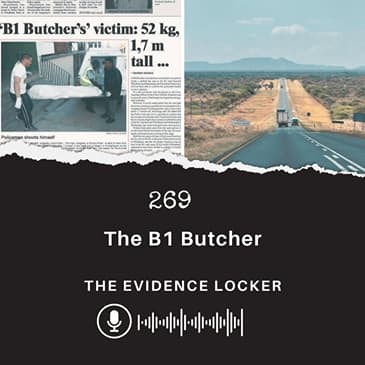
North of Windhoek, the B1 leaves the city behind and crosses long stretches of open country. It is one of Namibia’s main roads: the route people take to work, to visit family, or to reach a town that may still be hours away. Roadside lay-bys offer a place to stop before continuing the journey.
On Sunday afternoon, June 17th, 2007, a woman’s torso was found in a rubbish bin at one of those stops, about forty-two kilometres north of the capital. It had been cut into two pieces. Her head and limbs were missing, leaving police with no immediate way to identify her.
Three days later, a roadside cleaner was emptying a bin on the B1 south of Windhoek, near Rehoboth. As he tipped it, two human thighs fell out. Officers at the scene noticed that the remains were cold. The discoveries lay on opposite sides of the city, along a road travelled by thousands of people.
The woman was Sanna Helena Garoës. She was thirty-six, with a nineteen-year-old daughter and a five-year-old son. She had last been seen outside a restaurant in Windhoek on the Wednesday night before the first discovery. In the weeks that followed, her mother would travel to the police mortuary to identify her. But Sanna’s remains had been left in more than two places, and her family was still waiting to bring her home.
You are listening to: The Evidence Locker.
Thanks for listening to our podcast. This episode is made possible by our sponsors—be sure to check them out for exclusive deals. For an ad-free experience, join us on Patreon, starting at just $2 a month, with 25% of proceeds supporting The Doe Network, helping to bring closure to international cold cases. Links are in the show notes.
Our episodes cover true crimes involving real people, and some content may be graphic in nature. Listener discretion is advised. We produce each episode with the utmost respect for the victims, their families, and loved ones.
Namibia lies on the Atlantic coast of southern Africa, with Angola to its north, Botswana to its east and South Africa below it. It became independent from South Africa in 1990. The country is immense, and much of it is sparsely populated. Windhoek, in the central highlands, is its capital and economic centre. For people living in smaller towns, its shops, hospitals, schools and jobs are a reason to make the journey there.
One of the main routes into Windhoek is the B1. It comes up from the south, passes the city on its Western Bypass and continues north. Around the capital, the road connects places that feel quite separate on a map. For the investigators in June 2007, it connected two rubbish bins. They could not yet say whether the remains in them belonged to the same person.
South of Windhoek, the B1 passes through Kalkrand. It was home to fewer than three thousand people. A service station, a handful of shops and a bar served local people and passing traffic. Employment was limited. There was a primary school, but families with older children had to find a way to pay for schooling and accommodation elsewhere. Truck drivers stopped on the route, bringing trade to the village, although some residents spoke openly about the ways women could be exploited when there were so few other chances to earn money.
Sanna Helena Garoës was born in Kalkrand on December 14th, 1970. She grew up there and later moved to Windhoek. By 2007, she was thirty-six and had two children: a daughter of nineteen and a son of five. Her mother, Lena Engelbrecht, still lived in the town. Her nephew Hermanus Hansen had grown up with her in the family house.
In Windhoek, Sanna had a friend who went by the name Chichi. The two women had worked together on the streets, along with another friend, Melanie Janse. Chichi later told a reporter that she and Sanna had been very close. She knew the parts of the city where Sanna regularly looked for clients: Independence Avenue, Ausspannplatz and the area around the Zum Wirt restaurant. These are the personal details the public record gives us. They tell us something about Sanna's movements and her friendships, but little about the life she shared with her children.
The last reported sighting of Sanna was at about eleven o'clock on Wednesday night, June 13th, outside Zum Wirt on Independence Avenue. Chichi said she had seen her roughly a week earlier. What happened to Sanna after the sighting at the restaurant has never been publicly reconstructed. By Sunday afternoon, part of her body was beside the B1 north of Windhoek.
The first discovery brought police, forensic scientists and anxious families to the mortuary. The woman's age was initially estimated to be in her twenties. Officers described her approximate height and build and appealed for information. Several families whose daughters or relatives were missing came forward, hoping to recognise her, or fearing they would. Some of those missing women later came home. For this woman, police still needed an identification.
On the Wednesday morning, the roadside cleaner found the thighs roughly twenty-five kilometres north of Rehoboth. Chief Inspector Michael Unandapo of the Serious Crime Unit said officers believed they belonged to the woman whose torso had been found on Sunday. Scientists would have to establish that. Forensic staff examined the scene and removed the remains after photographs and possible evidence had been collected.
Officers reported that both finds had been cold to the touch. They considered whether the body parts had been stored in a fridge or freezer before being left by the highway. That was an investigative possibility, not proof of a particular location or method. The two bins were on opposite sides of Windhoek, and the rest of the woman's remains were still missing.
The geography brought older cases back into view. Nearly two years earlier, on August 20th, 2005, twenty-two-year-old Melanie Janse had been found beside the Western Bypass near the Van Eck Power Station. She was naked, and police initially suspected strangulation.
Chichi later said Melanie had been a close friend of hers and Sanna's. This was more than a resemblance between crime scenes. It was a connection between the women themselves.
A little over a month after Melanie's death, twenty-one-year-old Juanita Mabula was found beside another part of the bypass, near the Windhoek Country Club Resort. It was September 25th, 2005. Her head was missing. On October 24th, it was found beside a culvert on the B1 to the south of Windhoek. The spot was about fourteen kilometres north of where Sanna's thighs would later be found.
Police thought Juanita might have been a sex worker. Her family disputed that description. Whatever someone assumed about her work, Juanita was a young woman whose relatives had already faced an agonising decision. Her aunt Joey Swartz later described how the family buried Juanita's body before her head was found. When it was recovered four weeks later, they buried it separately.
The two 2005 deaths and the new discoveries had locations in common. Juanita and the woman in the bins had both been dismembered. But the causes of death and the evidence at the scenes did not yet establish one offender. Police had offered a reward of twenty thousand Namibian dollars for information in the earlier cases. After the discovery of the torso, they offered sixty thousand for information leading to the arrest of the person responsible for the latest death.
Newspapers had a name for that person: the B1 Butcher. The name moved much faster than the forensic work. To the public, it suggested a single killer travelling the highway. The police still had to find out who the woman was, how she had died and which, if any, of the other deaths were connected.
On July 11th, workers repairing a fence on a farm called Voigtland made a discovery in the veld east of Windhoek. Near the B6 road, they found a woman's head, lower legs and feet. Three middle toes were missing from each foot. The site was about thirty-five kilometres from the capital, on the road towards the airport. Police suspected that these remains belonged to the woman from the B1, but waited for identification and scientific examination.
Two days later, Sanna's mother came to the police mortuary in Windhoek. Lena Engelbrecht identified the remains as her daughter's. There was also an old bullet wound on one of the thighs that helped her recognise Sanna. Hermanus Hansen said the family had suspected it was her when that earlier discovery was made. The recovered head allowed them to give police her name. The parts had been found north, south and east of the city over almost four weeks. Her arms and hands had not been recovered.
The news went back to Kalkrand. In July, about twenty women gathered at the family home to support Lena and the children. Some were relatives of Melanie Janse and Juanita Mabula. Women came from Windhoek, Rehoboth and Tsumis Park to pray alongside people from Sanna's own village. Rosa Namises, an activist with Women's Solidarity, helped bring them together.
Hermanus, speaking for the family, asked the person who had killed Sanna to leave her missing arms somewhere they could be found. The family wanted to bury her properly. Joey Swartz was among the women who understood that request. She had been through the separate burials of her niece Juanita. There was no need for her to be told what waiting for another discovery felt like.
As the investigation continued, rumours ran ahead of the police. One story claimed a butcher by trade had been arrested; police denied it. Officers received tips and had to investigate them. Permanent roadblocks on routes around Windhoek prompted questions about how someone could have transported body parts past them. A checkpoint, however, could not account for every vehicle's contents. The investigators had several disposal sites, but no public account of where Sanna had been between Wednesday night and Sunday afternoon.
A separate incident in Windhoek drew attention at the end of July. A twenty-nine-year-old woman accused German national Heinz Knierim of raping and trying to strangle her in Otjomuise. He was arrested on August 1st. In the climate of the B1 investigation, his name circulated widely. He was charged in the Otjomuise case, not with the murder of Sanna, Melanie or Juanita. He disputed the woman's account and said other men had assaulted her and that he had tried to intervene. His case would remain before the courts for more than two years.
In late August, Sanna's family held a memorial service at the Beth-el Evangelical Lutheran Church in Katutura. A photograph of her smiling was carried into the church ahead of her casket. She was then laid to rest in Kalkrand. The Namibian reported that her daughter and young son had waited seven weeks for that farewell. Her arms still had not been found.
The name B1 Butcher surfaced again the following month, after a woman's body parts were found around Grootfontein, hundreds of kilometres to the north. A head and forearms were found near the state hospital on September 17th. Other remains were recovered in the following days. The discoveries were disturbing, and the public was already primed to see a series. Yet the Grootfontein case would follow a different path.
At first, relatives identified the woman as Jacoba Wilma Olivier, whom her mother had not seen in years. Police released Jacoba's name and began tracing her last movements. Then Jacoba saw her own photograph in a newspaper while she was in hospital at Outjo. She contacted the police. She was alive. Her mother Martha had identified the remains more than once and broke down at the briefing where the mistake was explained. The family had mourned someone who was living elsewhere; the woman in the mortuary still needed her real name.
In October, police received information that the wife of a nurse working at Grootfontein State Hospital had disappeared around the time the remains were found. The nurse was Kenneth Bunge Orina. He and his wife, Rose Chepkemoi Kiplangat, were Kenyan nationals and lived in accommodation on the hospital grounds. Rose was also a trained nurse. Orina was arrested on October 30th. In an early court appearance he said he had killed her during a struggle and had cut up her body afterward. At his later trial, he denied murder.
Forensic comparisons connected the remains to Rose's parents. In April 2011, the High Court convicted Orina of murdering his wife and attempting to defeat the course of justice by dismembering and disposing of her body. He received thirty years for murder and ten years on the second count. Rose was thirty-three, and she and Orina had a child. The Grootfontein woman was no longer unidentified. Her name was Rose, and her murder had been tried in court. She had been swept into public discussion of the B1 killings because of the way her body was found, but the person convicted of killing her was her husband.
For the cases closer to Windhoek, investigators sought help beyond Namibia. Three senior South African detectives with experience in serial murder investigations joined the inquiry in October 2007. Police examined the scenes, the relationships between the victims and the possibility that some of the deaths had different causes and different perpetrators. Chichi's friendship with both Sanna and Melanie mattered, but friendship alone could not establish that they had met the same killer.
One man whose death had occurred at the start of the 2007 investigation would become the focus of renewed attention. On June 19th, two days after Sanna's torso was found and a day before the discovery of her thighs, forty-year-old Hans Husselmann was found hanged in his flat in Windhoek West. He left a note for his family saying that his decision was a matter between himself and God. It was not a confession to any of the B1 murders.
Husselmann had a serious criminal past. In May 1988, he shot and robbed a man beside the B1 south of Rehoboth. The following month, he killed a hotel gatekeeper in Rehoboth by stabbing and beating him. He was sentenced in 1989 and served more than fourteen years before his release on parole in February 2004. He studied while in prison and gained technical qualifications. Afterward, he worked as a fitting and turning instructor at the Windhoek Vocational Training Centre.
In April 2008, the Republikein newspaper reported that preliminary DNA results appeared to connect Husselmann to the deaths of Juanita and Sanna. The Namibian sought comment from the police. An officer said samples from Husselmann's home seemed to indicate contact with Sanna, but the finding required further investigation. Investigators needed to establish how the material had got there and whether anyone else had been involved. Another source told the newspaper of possible matches involving material from Husselmann's flat and jacket, and DNA on a letter sent to police in connection with Juanita's killing.
Those reports were significant leads. They were not findings from a trial of Husselmann. He had died before Sanna was identified, and there could be no prosecution in which the forensic evidence was publicly tested against a defence. His earlier convictions and the fact that one murder had taken place beside the B1 did not prove he had killed these women. Nor did the reported DNA claims explain Melanie's death, for which police had noted injuries that did not necessarily fit the pattern suggested for Juanita and Sanna.
In February 2010, the case against Heinz Knierim reached its end. Magistrate Dinnah Usiku discharged him at the close of the prosecution's case because the evidence was insufficient to require him to present a defence. He was acquitted of the rape and attempted murder charges arising from the Otjomuise incident. He had never been charged with a B1 killing. His arrest and long detention had offered no answer to the deaths on the highway.
By then, years had passed since Sanna was seen outside Zum Wirt. The investigation had produced places, dates, reported forensic leads and an enduring nickname. It had also produced no conviction for her murder, or for those of Melanie and Juanita. The name B1 Butcher had covered the deaths of several women, including Rose's, even though Rose's killer was eventually identified and sentenced.
There is a photograph from Sanna's memorial service: a smiling woman brought into the church before the mourners followed her casket. The reporting tells us that she was a mother, a daughter and a friend; that her nephew remembered growing up with her in Kalkrand; and that the families of two other murdered women stood with hers. The people who gathered there did not need a nickname for the offender. They knew the woman they had come to mourn.
If you'd like to dive deeper into this case, check out the resources we used for this episode in the show notes.
Don’t forget to follow us on social media for more updates on today's case – you can find us on Facebook, Instagram, TikTok and X. We also have a channel on YouTube where you can watch more content.
If you enjoy what we do here at Evidence Locker, please subscribe on Apple Podcasts or wherever you're listening right now and consider leaving us a 5-star review.
This was The Evidence Locker. Thank you for listening!