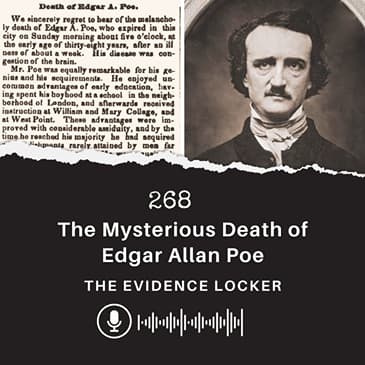
The Mysterious Death of Edgar Allan Poe | USA
On the afternoon of 3 October 1849, a compositor named Joseph Walker sat down to write an urgent letter. He addressed it to a local physician and acquaintance of the writer Edgar Allan Poe. The message was brief.
"There is a gentleman, rather the worse for wear, at Ryan's Fourth Ward Polls, who goes under the cognomen of Edgar A. Poe, and who appears in great distress. He says he is acquainted with you, and I assure you, he is in need of immediate assistance."
By the time the note reached its recipient, Baltimore's election day crowds were still spilling through the streets. Outside a public house being used as a polling place, one of America's most celebrated writers sat slumped in borrowed clothes that hung awkwardly from his frame. His face was pale. His speech was confused. At times he drifted into delirium. At others, he seemed almost aware of the people around him—before slipping away again.
No one could explain how he had arrived there.
Just five days earlier, Edgar Allan Poe had left Richmond, Virginia, with plans for a new life. He was engaged to be married. He hoped to launch his own literary magazine. Friends described him as optimistic—perhaps more hopeful than he had been in years.
Somewhere between Richmond and Baltimore, those plans changed. For nearly a week, his movements remain almost entirely undocumented. When he was finally found, he carried no coherent account of where he had been. The clothes he wore were not believed to be his own. Over the next four days, confined to a hospital bed, Poe drifted in and out of consciousness, unable—or unwilling—to explain what had happened.
He died before dawn on 7 October 1849. For more than a century and a half, physicians, historians and biographers have tried to reconstruct those missing days. This is not the story of how Edgar Allan Poe lived. It is the story of how one of literature's greatest mysteries began.
Intro Music & Disclaimer
You are listening to: The Evidence Locker.
Thanks for listening to our podcast. This episode is made possible by our sponsors—be sure to check them out for exclusive deals. For an ad-free experience, join us on Patreon, starting at just $2 a month, with 25% of proceeds supporting The Doe Network, helping to bring closure to international cold cases. Links are in the show notes.
Our episodes cover true crimes involving real people, and some content may be graphic in nature. Listener discretion is advised. We produce each episode with the utmost respect for the victims, their families, and loved ones.
The case:
Edgar Allan Poe was born in Boston on the 19th of January 1809, at a time when the United States was still a young nation finding its feet. His parents, David and Eliza Poe, were travelling actors, a profession that offered little financial security and even less social standing. Before Edgar reached the age of three, both parents were dead. His father had abandoned the family, and his mother succumbed to tuberculosis when Edgar was just two years old. The little boy was separated from his siblings and taken in by a wealthy Richmond tobacco merchant, John Allan, and his wife, Frances.
Although he was never formally adopted, Edgar took the Allan surname as his middle name and spent much of his childhood in comfortable surroundings. It was, however, a relationship that would become increasingly strained. John Allan expected the young man to pursue a respectable career in business, while Edgar was determined to become a writer. Money became a recurring source of conflict between them, particularly after Poe enrolled at the newly established University of Virginia in 1826. Tuition was paid, but little allowance was provided for living expenses. Burdened by debt, Poe turned to gambling in an attempt to make ends meet. Instead, his losses mounted, and after less than a year he left the university. The rift with John Allan widened and, despite occasional reconciliations, the two men never truly repaired their relationship. By the time Allan died in 1834, Poe had effectively been disinherited.
Writing, meanwhile, became both Poe's passion and his livelihood. He published poetry while still in his teens before turning increasingly to prose, literary criticism and magazine editing. The American publishing industry of the 1830s and 1840s was unforgiving. Authors were often paid only once for their work, with little protection against unauthorised reprinting. Even writers whose names were widely recognised struggled to earn a dependable income. Poe developed a reputation as one of the country's sharpest literary critics, admired for his intellect but equally feared for his uncompromising reviews. At the same time, his own stories began attracting attention. Tales such as The Fall of the House of Usher, The Murders in the Rue Morgue and The Tell-Tale Heart established him as a master of psychological horror and detective fiction, while his poem The Raven, published in 1845, made him one of the most recognisable literary figures in America almost overnight. Fame, however, did not bring financial security. Despite his growing reputation, Poe continued to move frequently between cities, taking editing positions that rarely lasted and constantly searching for a stable source of income.
Behind the public success lay repeated personal tragedy. In 1836, at the age of twenty-seven, Poe married his cousin, Virginia Clemm. She was just thirteen years old, although the marriage licence initially recorded her as older. Modern readers often find the age difference confronting, but marriages involving young teenagers, while uncommon, were not unheard of in parts of nineteenth-century America. Contemporary accounts suggest that theirs was an affectionate relationship built on companionship rather than scandal, with Virginia, her mother Maria Clemm and Poe forming a close-knit household that weathered years of financial hardship together.
In 1842, Virginia suffered a pulmonary haemorrhage while singing at home, the first unmistakable sign of tuberculosis. For the next five years her health steadily declined. Poe devoted himself to caring for her, but watched helplessly as the illness progressed. She died in January 1847 at just twenty-four years of age. Friends later recalled that Poe never fully recovered from the loss. He experienced periods of profound grief and struggled with bouts of depression, while his already complicated relationship with alcohol became the subject of increasing public attention. Although later writers often portrayed him as a habitual drunkard, many modern biographers argue that the evidence points instead to a man who tolerated alcohol poorly and whose episodes of drinking, though sometimes disastrous, were intermittent rather than constant.
By the summer of 1849, Edgar Allan Poe appeared to be emerging from one of the darkest periods of his life. He had returned to Richmond, Virginia, a city that had once been home but now welcomed him as something of a literary celebrity. His public readings drew respectable crowds, and newspapers spoke favourably of his lectures. Friends remarked that he looked healthier than he had in years. Whatever personal struggles he continued to face, he seemed determined to put them behind him.
One reunion, in particular, rekindled an old chapter of his life. Before marrying Virginia, Poe had been romantically involved with a Richmond widow named Elmira Royster. Years earlier, while Poe was away studying, her father intercepted his letters and discouraged the relationship. Believing herself abandoned, Elmira married another man. By 1849 she, too, was widowed, and when Poe returned to Richmond, the pair met again after almost three decades apart.
Their courtship progressed quickly. Friends later recalled that Poe seemed genuinely optimistic about the future, speaking openly of marriage and a more settled life. Although no formal engagement announcement appeared in the newspapers, there is little doubt that the couple intended to marry. Surviving letters written by Elmira after Poe's death refer to their plans together, while several contemporaries independently confirmed that a wedding was expected to take place within weeks.
Poe's ambitions extended beyond his personal life. For years he had dreamed of publishing his own literary journal, free from the editors and publishers whose decisions so often dictated his career. He intended to call it The Stylus. Unlike the magazines for which he had previously worked, The Stylus would give him complete editorial control and provide a platform for serious literary criticism, essays and fiction. It was an ambitious undertaking, but one he believed was finally within reach. He spent much of September meeting potential financial backers and gathering subscriptions, convinced that success was just around the corner.
Poe left Richmond by steamboat, bound for Baltimore. Before continuing north to Philadelphia and New York, he planned to stop briefly in Baltimore, where his aunt and mother-in-law, Maria Clemm, was staying. He also intended to collect some personal belongings and attend to a few business matters before travelling onward to meet publishers in New York. If all went according to plan, he would return to Richmond shortly afterwards to marry Elmira.
There is good evidence that Poe was in high spirits before his departure. The night before leaving, he visited friends, had dinner at Sadler’s, and spoke enthusiastically about the months ahead. He carried letters of introduction, discussed prospective contributors for The Stylus, and appeared confident that both his professional and personal fortunes were finally changing. One acquaintance later remarked that he had never seen Poe "in better health or spirits."
And at around four o'clock on the morning of the 27th of September, Poe boarded a steamer leaving Richmond. It was the last time anyone there could say with certainty where he was headed.
The journey itself should have been uneventful. Travelling between Richmond, Baltimore, Philadelphia and New York was common enough by the late 1840s, involving a combination of steamships and rail travel. Even allowing for delays, Poe was expected to reach Philadelphia within a day or two.
He never arrived.
From the moment he left Richmond, the documentary trail becomes surprisingly thin. Historians have been able to piece together fragments of his intended movements through letters, newspaper notices and the recollections of friends, but for nearly a week there is no verified account of where Edgar Allan Poe went, whom he met, or what happened to him.
Baltimore was holding municipal elections on Wednesday, the 3rd of October 1849. Across the city, polling stations were crowded from early morning, with voters, political workers and curious onlookers moving in and out of public buildings. One such polling place operated out of Ryan's Fourth Ward Polls, also known as Gunner's Hall, a tavern on East Lombard Street.
Sometime during the afternoon, a local compositor named Joseph W. Walker noticed a man sitting outside the establishment. The stranger appeared gravely ill. His clothes were dishevelled, his face was pale, and he seemed unable to care for himself. As Walker drew closer, he realised he recognised the man.
It was Edgar Allan Poe.
Concerned by his condition, Walker penned a hurried note to Dr Joseph E. Snodgrass, a physician who also happened to know Poe personally. The original letter survives today. It reads:
"Dear Sir—There is a gentleman, rather the worse for wear, at Ryan's Fourth Ward Polls, who goes under the cognomen of Edgar A. Poe, and who appears in great distress, and he says he is acquainted with you. As I know you have some acquaintance with him, I write to ascertain if you can do anything for his assistance. Yours, in haste, Joseph W. Walker."
The letter contains remarkably little detail, yet every word has since been examined by generations of scholars. Walker did not describe Poe as intoxicated, nor did he speculate about illness or injury. He simply observed that the writer was in "great distress" and clearly needed help.
Dr Snodgrass responded to the request and accompanied Poe to the nearby Washington College Hospital. Along the way, those assisting him noticed something immediately unusual. The clothes Poe was wearing did not appear to belong to him... It raised concern, but ultimately, helping Poe was of greater importance.
Edgar Allan Poe was admitted to Washington College Hospital during the afternoon of the 3rd of October. The hospital stood only a short distance from where he had been found, and for the next four days it would become the setting for one of literature's greatest mysteries.
The physician responsible for Poe's care was Dr John Joseph Moran. Ironically, much of what is believed about Poe's final hours comes from Moran himself. Unfortunately for historians, his recollections changed over time. In the years following Poe's death, Moran published lectures and articles describing the writer's condition, but many of these accounts contradicted one another. As a result, modern scholars generally treat his later statements with caution, relying instead on those details that remained broadly consistent or were supported by contemporary records.
What does appear consistent is that Poe drifted in and out of consciousness. At times he was lucid enough to respond to simple questions, but he never provided a coherent explanation for how he had come to be in Baltimore or what had happened during the previous week. Attempts to establish where he had travelled, whom he had met or why he was wearing unfamiliar clothing yielded no meaningful answers.
Several visitors came to see him during his final days. Dr Joseph Snodgrass later recalled that Poe appeared confused and unable to sustain a conversation. His aunt and mother-in-law, Maria Clemm, remained in New York, unaware that anything was wrong until after his condition had deteriorated. Friends in Baltimore did what they could to ensure he was cared for, but there was little anyone could do beyond waiting and hoping he might recover enough to explain the events that had brought him there.
As the days passed, Poe's condition worsened. He became increasingly restless, slipping between periods of agitation and exhaustion. According to Dr Moran, there were moments when he appeared to recognise those around him, only to become disoriented again a short time later. Whether this confusion resulted from illness, injury or something else entirely has never been established.
Perhaps the most frequently quoted aspect of Poe's final hours concerns his supposed last words. For generations they have appeared in biographies, documentaries and works of fiction alike.
According to Dr Moran, Poe's final words were:
"Lord, help my poor soul."
It is a simple and poignant sentence, but historians have urged caution. Moran did not publish this account until years after Poe's death, and over time he offered several different versions of the writer's final moments. There is no independent witness to confirm exactly what Poe said—or whether he said anything memorable at all. Like so much else surrounding his death, the story rests largely on the recollections of a single man.
In the early hours of Sunday, the 7th of October 1849, Edgar Allan Poe died at the age of forty.
The cause of death was reported simply as congestion of the brain, a broad nineteenth-century medical term that was commonly used when the precise cause of death was uncertain. It could refer to a range of conditions, from stroke and inflammation to intoxication or severe infection, and offers little insight by modern medical standards.
Edgar Allan Poe was buried on the afternoon of the 8th of October 1849, in the cemetery of Westminster Presbyterian Church in Baltimore. The funeral was a modest affair. Contemporary accounts suggest that fewer than ten people stood beside the grave, among them his cousin Neilson Poe, the Reverend W. T. D. Clemm and a handful of family friends. The service lasted only a few minutes before the mourners quietly dispersed.
There was little indication that the man being laid to rest would one day be regarded as one of America's greatest writers. His grave itself reflected the simplicity of the occasion. Poe was buried near the rear wall of the churchyard beneath a small sandstone marker bearing only a plot number. It would be more than twenty-five years before his remains were moved to the prominent monument that visitors see today.
Had Poe died in the twenty-first century, investigators would have had access to medical imaging, blood toxicology, forensic pathology and extensive hospital records. None of that existed in Baltimore in 1849.
No autopsy was performed. His death certificate has since been lost. The hospital records documenting his treatment no longer exist. Whether they were misplaced, discarded or destroyed over time is unknown, but their absence has left historians with remarkably little contemporary evidence from which to reconstruct Poe's final illness. Almost everything written about his last days relies on newspaper reports, personal correspondence and the recollections of those who claimed to have seen him.
Even those accounts present difficulties. Dr John Joseph Moran outlived Poe by more than three decades and spent much of that time speaking publicly about the famous patient who had died under his care. Unfortunately, his recollections became increasingly elaborate as the years passed. Details were added, conversations expanded and incidents described that appeared nowhere in his earliest accounts. Modern biographers generally agree that Moran's memories became less reliable with time, making it difficult to distinguish genuine recollection from embellishment.
If the uncertainty surrounding Poe's final days was not enough, his reputation suffered another blow almost immediately after his death.
Just two days later, on the 9th of October, an obituary appeared in the New-York Daily Tribune. It was signed simply "Ludwig." The author was Rufus Wilmot Griswold, a fellow editor and literary rival who had clashed with Poe on more than one occasion. Many readers did not realise that "Ludwig" was Griswold, nor that the obituary had been written by someone who bore little affection for the deceased.
Griswold described Poe as unstable, immoral and hopelessly addicted to drink, portraying him as a man consumed by vice and self-destruction. It was a devastating character assessment, made all the more influential because Poe himself was no longer alive to challenge it.
The campaign did not end there.
Within months, Griswold appointed himself Poe's literary executor—despite having no legal authority to do so—and published a memoir alongside a collection of Poe's works. In it, he repeated and expanded many of the claims made in the obituary, presenting an image of Poe as a brilliant but deeply flawed genius whose life had unravelled through alcoholism and erratic behaviour.
Although friends and family strongly disputed Griswold's account, the memoir reached a wide audience and remained enormously influential for decades. It shaped public perception of Edgar Allan Poe long before modern scholarship revisited the evidence, and many of its claims continued to appear in biographies well into the twentieth century.
The irony is difficult to ignore.
One of the world's greatest writers, whose stories often explored unreliable narrators and blurred the line between truth and illusion, left behind a mystery that was almost immediately obscured by conflicting testimony, missing records and competing narratives.
More than 175 years later, historians still cannot agree on what caused Edgar Allan Poe's death. The absence of a post-mortem examination, together with the loss of his medical records and death certificate, means that no definitive explanation is possible. What remains are contemporary newspaper reports, personal correspondence and the recollections of those who claimed to have witnessed his final days.
For decades, alcohol was considered the most likely explanation. That perception was shaped largely by Dr Joseph Snodgrass, who later cited Poe's death in support of the Temperance Movement, and by Rufus Griswold, whose damaging memoir portrayed Poe as a habitual drunkard. Modern biographers have challenged that view. While Poe undoubtedly struggled with alcohol at times, several friends maintained that he had remained sober in the weeks before leaving Richmond and that even small amounts of alcohol affected him profoundly. A brief relapse cannot be ruled out, but alcohol alone does not adequately explain his condition.
Another enduring theory centres on the polling station where Poe was found. Because Ryan's Fourth Ward Polls was operating as an election venue, speculation arose that he had fallen victim to cooping—an election fraud in which men were abducted, disguised and forced to vote repeatedly while under the influence of alcohol or drugs. The theory offers a possible explanation for Poe's unfamiliar clothing and confused state, but no contemporary evidence directly links him to the practice.
Medical explanations have been equally varied. In 1996, Dr R. Michael Benitez proposed that Poe's symptoms were consistent with rabies, while others have suggested diabetes, epilepsy, meningitis, encephalitis, stroke, heart disease or a brain tumour. Speculation has also arisen that Poe may have been assaulted, robbed or poisoned during the days in which his movements remain unknown. Each theory accounts for part of the story, but none explains it in its entirety.
Perhaps that is why the mystery has endured for so long. No explanation satisfactorily accounts for Poe's unexplained disappearance, his unfamiliar clothing, his confused state outside Ryan's Fourth Ward Polls and his rapid decline in hospital. Without the evidence modern investigators would expect, those questions are unlikely ever to be answered.
It seems fitting that one of literature's greatest writers should leave behind one of its greatest mysteries. In his 1844 short story, The Premature Burial, Edgar Allan Poe wrote:
"The boundaries which divide Life from Death are at best shadowy and vague. Who shall say where the one ends, and where the other begins?"
Outro:
If you'd like to dive deeper into this case, check out the resources we used for this episode in the show notes.
Don’t forget to follow us on social media for more updates on today's case – you can find us on Facebook, Instagram, TikTok and X. We also have a channel on YouTube where you can watch more content.
If you enjoy what we do here at Evidence Locker, please subscribe on Apple Podcasts or wherever you're listening right now and consider leaving us a 5-star review.
This was The Evidence Locker. Thank you for listening!
Resources
Web
The Edgar Allan Poe Society
Encyclopedia Virginia
Edgar Allan Poe Society of Baltimore
Poe Museum
Articles
Here at last he is happy – The Death and Burial of Edgar Allan Poe
Edgar A. Poe: Mournful and Never-ending Remembrance
University of Maryland – 175 Years Later, Mystery Still Shrouds Poe’s Death
Murder or Madness: What Really Killed Edgar Allen Poe?
Created & Produced by Sonya Lowe
Narrated by Noel Vinson
Music: “Nordic Medieval” by Marcus Bressler
Background track: Doblado Studios: https://www.youtube.com/c/DobladoStudios
©2026 Evidence Locker Podcast
All rights reserved. This podcast or any portion thereof may not be reproduced or used in any manner whatsoever without the express written permission of the publisher except for the use of brief quotations in a podcast review.