The Monster with 21 Faces | Japan
On the morning of October 7th, 1984, an employee stocking shelves at a supermarket in Japan noticed something unusual among the boxes of Morinaga sweets. One of the packets had been tampered with. Attached to it was a handwritten warning.
"Danger. Contains poison."
Police were called immediately. Before long, similar discoveries were made in other stores across the country. Some of the sweets had been laced with potassium cyanide. Others carried warnings placed there by the offender himself, as though he wanted them to be found before anyone was harmed.
Within hours, products were disappearing from supermarket shelves. Television broadcasts warned parents not to let their children eat certain confectionery. A simple trip to the corner shop had suddenly become a cause for alarm.
The person responsible had already achieved exactly what they wanted. They had convinced millions of people that something as ordinary as a box of sweets could no longer be trusted. The letters that followed were signed with a name taken from Japanese detective fiction: The Monster with 21 Faces.
By then, however, the mystery had already been unfolding for more than six months. It had begun not in a supermarket, but at the home of one of Japan's most prominent businessmen…
You are listening to: The Evidence Locker.
Thanks for listening to our podcast. This episode is made possible by our sponsors—be sure to check them out for exclusive deals. For an ad-free experience, join us on Patreon, starting at just $2 a month, with 25% of proceeds supporting The Doe Network, helping to bring closure to international cold cases. Links are in the show notes.
Our episodes cover true crimes involving real people, and some content may be graphic in nature. Listener discretion is advised. We produce each episode with the utmost respect for the victims, their families, and loved ones.
By the mid-1980s, Japan had become one of the world's great economic success stories. Less than four decades after the devastation of the Second World War, the country had rebuilt itself into a global industrial powerhouse. Japanese electronics, motor vehicles and consumer goods were respected around the world for their quality and reliability. At home, that same reputation extended to everyday life. There was a quiet confidence in the products people bought and the companies that made them.
Confectionery was no exception. For generations, sweets had been woven into Japanese culture, from neighbourhood shops to seasonal gift boxes in department stores. Parents rarely questioned whether the treats they bought were safe. They simply were.
Among the best known of those companies was Ezaki Glico. Founded in Osaka in 1922, Glico had grown into one of Japan's largest confectionery manufacturers. Its iconic Running Man sign overlooking the Dotonbori Canal had become one of Osaka's most recognisable landmarks, while products such as Pocky, Pretz and Almond Chocolate were enjoyed throughout the country. The company represented exactly what modern Japanese industry aspired to be: innovative, dependable and trusted.
That trust extended far beyond the supermarket shelf. Corporate reputation carried enormous weight in Japan, where a company's public image was considered just as valuable as its products. A scandal could destroy decades of goodwill, and executives accepted responsibility not only for their own actions, but for failures within the organisations they led.
Law enforcement enjoyed a similarly strong reputation. Violent crime was comparatively rare, and kidnappings for ransom were almost unheard of. Most people believed that if something dangerous happened, the authorities would quickly restore order.
That sense of certainty would soon be tested. In March 1984, an audacious kidnapping shattered the assumption that even the country's most prominent business leaders were beyond the reach of criminals. What initially appeared to be a straightforward ransom case would evolve into something Japan had never experienced before.
The offender was not interested solely in money. Instead, the country found itself facing an anonymous adversary who understood that fear could spread much faster than violence. Rather than attacking people directly, the perpetrator targeted something far more difficult to repair: the public's confidence in the institutions they trusted every day.
On the evening of March 18th, 1984, Katsuhisa Ezaki, the 42-year-old president of the Ezaki Glico company, was at home with his family in Nishinomiya, a residential city between Osaka and Kobe. It was a Sunday night, and there was no reason for anyone inside the house to believe they were in danger. Glico was one of Japan’s best-known confectionery companies, and Ezaki was a prominent businessman, but he was not someone the public associated with violent crime. In Japan at the time, kidnappings for ransom were rare, and an attack on the head of a major food company was almost unthinkable.
At around 9pm, two masked men broke into the neighbouring house on the property, home to Ezaki’s 70-year-old mother. One was armed with a pistol, the other with a rifle. They tied her up, cut the phone line, and took a spare key to her son’s house next door. Terrified, she told them where to find him.
Using the stolen key, the men entered the house and tied up Ezaki’s wife and young daughter before pulling Ezaki himself, naked, from the bathtub. There was very little he could do without putting his family in danger. The kidnappers forced him to dress, then marched him out of his home and into a waiting vehicle. By the time police were called, the president of Glico had vanished into the night.
The following day, the kidnappers made contact and delivered their demands. They wanted one billion yen in cash and 100 kilograms of gold bullion. It was an enormous ransom, aimed not only at the Ezaki family, but at the company itself. Police set up roadblocks and began searching for both Ezaki and his captors, while Glico executives waited for further instructions. For a brief moment, the case appeared to be a straightforward kidnapping, shocking because of the victim’s public position, but still familiar in its basic shape: a wealthy man had been abducted and criminals wanted money for his return.
Then, three days after he was taken, Katsuhisa Ezaki escaped. He had been held inside a warehouse in Ibaraki City, north of Osaka, restrained with rope and chains. When one of his captors left the building, Ezaki managed to free himself. He climbed out of an upstairs window and fled barefoot, eventually reaching a nearby house where the occupants contacted police. He was shaken, but alive.
To the public, the escape felt like the end of the ordeal. The victim had survived. The ransom had not been paid. The kidnappers had failed.
But in reality, the abduction of Katsuhisa Ezaki was only the beginning. Whoever had taken him was not finished with Glico, and the next phase of the crime would prove to be far more disturbing than the kidnapping itself.
The relief following Ezaki's escape proved to be short-lived. Although the kidnappers had lost their hostage, they had not abandoned their demands. Within days, threatening letters began arriving at Glico's headquarters, as well as at newspapers and police departments. Their tone was unlike anything investigators had encountered before. Rather than simply demanding money, the anonymous writers mocked the authorities, ridiculed the company and appeared to take genuine pleasure in the attention their crime was receiving.
The messages made it clear that Glico remained the target. On April 10th, several vehicles belonging to company executives were set alight in the parking area of Glico's headquarters in Nishinomiya. Just days later, investigators discovered a plastic container filled with hydrochloric acid near one of the company's facilities. The offender claimed responsibility for both incidents, warning that the attacks would continue unless their demands were met.
At first, police believed they were dealing with extortionists whose plans had simply been disrupted by Ezaki's escape. Yet the crimes that followed did not fit that explanation. Instead of negotiating privately, the offender seemed determined to involve the public. Every letter was carefully written. Every threat was delivered with theatrical precision. Copies were sent to newspapers, ensuring that each new development would dominate the headlines before investigators had time to respond.
The offender was no longer communicating only with Glico. They were communicating with the whole of Japan.
As the weeks passed, the letters grew increasingly confident. They taunted detectives for their lack of progress, criticised the media when reports were inaccurate and seemed to relish the enormous police operation unfolding around them. The writer displayed an unusual command of language, switching effortlessly between humour, sarcasm and menace. At times, the letters almost read like chapters from a detective novel, with the police cast as incompetent protagonists forever one step behind their invisible adversary.
Then, in one of those letters, the anonymous author finally introduced themselves. They signed it with a name that readers across Japan instantly recognised… The Monster with 21 Faces.
To the average reader, the signature at the bottom of the letter was unsettling enough. But to many Japanese people, it carried another meaning entirely. The Monster with 21 Faces was not an invention of the extortionist. It was borrowed from the pages of Japanese detective fiction.
In the 1930s, celebrated mystery writer Edogawa Rampo created a master criminal known as The Fiend with Twenty Faces — a brilliant disguise artist who delighted in taunting detectives, manipulating the press and staying one step ahead of the law. The name was a nod to Edgar Allan Poe, whose detective fiction Rampo admired, and the character had long been part of Japanese popular culture.
Whether the offender chose the name out of admiration or irony remains unknown. But the comparison was impossible to ignore. Like Rampo's fictional villain, the real-life Monster seemed less interested in violence than in the spectacle surrounding it. Every letter was carefully composed. Every demand appeared calculated to generate headlines. Even the insults directed at police carried an almost playful arrogance, as though the investigation itself had become part of an elaborate game.
The letters were handwritten in neat Japanese script and often contained regional dialect, suggesting that the author was familiar with the Kansai region around Osaka and Kobe. They mocked investigators for wasting time, criticised newspaper coverage and occasionally praised companies that behaved according to the writer's expectations. At times, the tone shifted unexpectedly from threatening to humorous, making it impossible to predict what would come next.
Police were no longer hunting a conventional kidnapper. They were chasing an anonymous personality.
The name quickly became front-page news. Newspapers across the country began referring to the offender simply as The Monster with 21 Faces, and before long, the public did the same. The kidnappers who had abducted Katsuhisa Ezaki were disappearing behind a new identity—one that seemed almost larger than life.
Meanwhile, the threats continued. Although Glico remained the primary target, the campaign was beginning to evolve. The anonymous letters hinted that other companies could soon find themselves in the Monster's sights, and investigators realised they were dealing with something far broader than an extortion attempt against a single confectionery manufacturer.
The case was about to expand beyond Glico, and with it, the fear would spread far beyond one company.
Throughout the spring and summer of 1984, the letters continued to arrive with unsettling regularity. Sometimes they demanded money. Other times they simply ridiculed the police for their inability to catch the offenders. Each new message generated another wave of newspaper headlines, and with every headline, the Monster with 21 Faces became more infamous.
The letters continued to be sent to newspapers before, or at the same time as, the police, ensuring journalists often learnt of new threats alongside detectives.
Negotiations between Glico and the extortionists continued for months. Instructions were delivered through anonymous letters and telephone calls, directing company representatives to leave vast sums of money at carefully chosen locations. Detectives watched railway stations, motorway rest areas and quiet roadside lay-bys, hoping the offenders would finally reveal themselves.
Each time, they slipped away. Meanwhile, the campaign was beginning to spread beyond Glico. The offenders claimed they had no quarrel with ordinary people, only with large corporations. Yet the distinction became increasingly difficult to believe as their threats grew more extreme.
In October 1984, they announced that they had laced Glico confectionery with potassium cyanide. The claim immediately triggered a nationwide response. Supermarkets hurriedly removed Glico products from their shelves, while police searched warehouses, shops and distribution centres across the country. Although no contaminated Glico products were ever recovered, the disruption was enormous. Millions of yen worth of confectionery was destroyed, and the company's reputation suffered another devastating blow.
Then, just as Glico slowly began recovering, the Monster turned its attention elsewhere. Morinaga, another of Japan's largest confectionery manufacturers, became the next target. This time, the threats proved even more alarming. Instead of merely claiming that products had been poisoned, the offenders quietly placed confectionery on supermarket shelves themselves. Attached to several packets were handwritten notices warning customers not to eat the contents because they contained potassium cyanide.
It was a bizarre contradiction. The Monster threatened mass poisoning, yet also warned the public how to avoid becoming victims.
Police raced to locate every contaminated product before anyone purchased it. Fortunately, every poisoned packet discovered had first been identified by supermarket employees or customers who noticed the warning labels. No one consumed the cyanide-laced sweets.
But that hardly lessened the fear. Parents stopped buying confectionery for their children. Retailers struggled to reassure anxious customers. Supermarkets increased security, while manufacturers introduced tamper-evident packaging to restore public confidence. For the first time, ordinary Japanese families found themselves questioning whether something as innocent as a box of chocolates could be trusted.
The Monster with 21 Faces had achieved something remarkably rare. Without firing another shot or kidnapping another victim, they had managed to frighten an entire nation.
By now, the investigation had grown into one of the largest criminal operations Japan had ever seen. Thousands of officers had been assigned to the case, and every new letter from the Monster triggered another carefully planned surveillance operation.
The offenders continued to demand money, but collecting the ransom seemed almost secondary. They appeared far more interested in demonstrating that they could outwit the authorities whenever they chose.
One of the most significant exchanges took place in June 1984. Following detailed instructions in one of the Monster's letters, an investigator posed as a Marudai Ham employee and boarded a train toward Kyoto, carrying the ransom money. Plain-clothes detectives watched from nearby platforms, convinced they were finally about to identify the person behind the extortion campaign.
A man in the same carriage immediately caught the investigator's attention. He was powerfully built, with short, permed hair and glasses, and something about his narrow, watchful eyes gave him an almost fox-like appearance. He seemed calm and entirely unbothered by the surveillance closing in around him. He shadowed the undercover investigator throughout the journey. Detectives quietly followed, careful not to reveal the surveillance operation. Every movement suggested they were watching the right person.
Then, as the train reached Kyoto Station, something changed. The man glanced towards the detectives. Whether he recognised them as police, noticed their behaviour, or simply sensed that something was wrong has never been established. Without appearing to panic, he stepped off the train, crossed the platform and disappeared into the crowd before officers could react. By the time detectives realised they had lost him, he was gone. It was an astonishing failure.
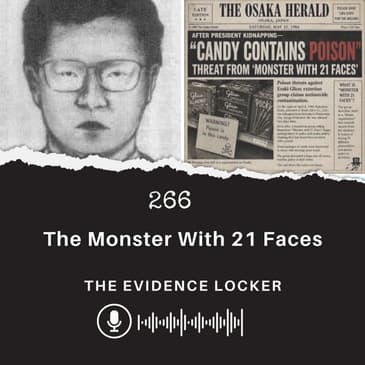
Police released an artist's impression of the mysterious suspect, hoping someone would recognise him. Newspapers quickly dubbed him the Fox-Eyed Man, and before long his face became almost as famous as the Monster's signature itself. Thousands of people claimed they had seen him. Hundreds of new leads flooded into police headquarters. None of them led to an arrest.
To this day, investigators cannot say with certainty whether the Fox-Eyed Man was the Monster himself, an accomplice, or simply an innocent traveller whose unfortunate resemblance to the suspect forever tied him to one of Japan's greatest unsolved mysteries.
For detectives, however, the encounter was devastating. They had been within metres of the man they believed could unravel the entire case. And once again, he had slipped quietly back into the crowd.
As 1985 progressed, the Monster with 21 Faces continued to dictate the pace of the investigation. Every new letter sent detectives scrambling. Every reported sighting generated another round of interviews. Hundreds of officers followed up thousands of leads, yet the investigation seemed no closer to identifying the people responsible. The offenders appeared to know exactly how police would respond, and they exploited that knowledge relentlessly.
By then, the case had spread far beyond Hyogo Prefecture. Police forces across Japan were sharing intelligence, while manufacturers tightened security at factories, warehouses and distribution centres. Supermarkets installed surveillance cameras and instructed employees to inspect shelves for tampered products. Companies introduced sealed packaging, a practice that would eventually become standard throughout the industry.
Despite these efforts, the Monster always seemed one step ahead. The letters mocked investigators for their failures and occasionally congratulated companies that had handled the threats well. At other times, they abruptly changed direction, abandoning one target and selecting another. To police, there appeared to be no consistent pattern. The offenders were unpredictable, patient and disciplined.
The investigation became a matter of national pride. Over the course of the case, more than a million police officers were involved in some capacity, chasing down upward of 28,000 tips and investigating nearly 125,000 persons of interest, making it one of the largest criminal investigations in Japanese history. Yet despite the enormous manpower, the extensive surveillance operations and the countless hours devoted to analysing every letter and telephone call, investigators could not identify a single suspect who could be linked conclusively to the crimes.
The pressure weighed heavily on those leading the case. Among them was Superintendent Yamamoto, the head of the Shiga Prefectural Police, whose officers had become heavily involved after the extortion campaign shifted towards House Foods. Like many senior investigators, he carried the burden of repeated failures in full view of an increasingly critical public. Newspapers questioned the competence of the police, while the Monster continued to ridicule them in letter after letter.
On August 7th, 1985, hours after being relieved of his post, Superintendent Yamamoto took his own life, dousing himself in kerosene and setting himself alight in the back garden of his official residence. His death sent shockwaves through Japan.
Although no one suggested that the Monster had intended such an outcome, many people regarded Yamamoto as another casualty of the affair. The investigation had claimed no lives through poisoned confectionery, yet its relentless psychological toll had reached even the country's most senior police officers.
Towards the end of 1985, the correspondence became noticeably less frequent. For more than a year, the Monster with 21 Faces had dominated newspaper headlines. Every letter had triggered another police operation, another press conference and another wave of public anxiety. Then, almost without warning, the campaign began to lose momentum.
The final known letters retained the same mocking tone that had characterised the case from the beginning. The writer continued to taunt investigators, suggesting they had wasted enormous time and resources chasing shadows. But there was also the sense that the game itself had run its course.
In the final letter, sent to Shiga police five days after Yamamoto's death, the Monster mocked the superintendent's death as pointless, insisted they had nothing left to hide, and declared they were done tormenting food companies for good.
With that, the letters stopped.
There were no further ransom demands. No more poisoned confectionery appeared on supermarket shelves. The anonymous phone calls ceased, and the police surveillance operations were gradually scaled back. For investigators, the silence was almost as frustrating as the threats had been.
There was no dramatic arrest. No final mistake by the offenders. No confession or anonymous tip that explained who had orchestrated one of Japan's most extraordinary criminal campaigns. The offenders simply disappeared, leaving behind thousands of pages of investigative reports, stacks of handwritten letters and a nation still searching for answers.
As the months turned into years, active leads began to dry up. Detectives revisited old evidence, interviewed witnesses again and re-examined the letters for hidden clues, but nothing brought them closer to identifying the Monster with 21 Faces.
Time, rather than police work, became the investigation's greatest enemy. Under Japanese law at the time, serious offences were subject to statutes of limitation. As each year passed, the possibility of bringing those responsible before a court grew smaller. The kidnapping of Katsuhisa Ezaki reached its legal time limit first. Other offences followed. Eventually, even the attempted poisonings and extortion fell beyond the reach of prosecution.
Like many unsolved crimes, the Glico-Morinaga case has inspired decades of speculation. Because no one was ever charged, investigators, journalists and criminologists have all tried to answer the same question: Who was the Monster with 21 Faces?
One theory suggests that the offenders had ties to organised crime. The ransom demands, the surveillance and the careful planning all point towards experienced criminals, and Japan's yakuza organisations certainly possessed the resources to carry out such a campaign. Yet the case lacks many hallmarks of organised crime. The yakuza traditionally preferred quiet negotiation to public spectacle, and terrifying consumers on a national scale would have been bad for business.
Others have suggested that the offender had intimate knowledge of the food industry. The campaign focused almost exclusively on major confectionery manufacturers, and the letters showed a clear understanding of corporate procedure and media relations. Some investigators wondered whether the author had once worked within one of the companies, or held a personal grievance against Japan's corporate establishment.
There has also been speculation that the campaign was politically motivated, an attack on Japan's economic success rather than a genuine attempt to extort money. Certainly, the offenders seemed to derive as much satisfaction from damaging reputations as they did from demanding ransom.
Perhaps the most compelling theory is also the simplest. The Monster with 21 Faces appeared to enjoy manipulation more than profit.
Although enormous sums of money were demanded, the offenders repeatedly abandoned opportunities to collect the ransom, devoting far more effort to elaborate letters and media attention than to actually getting paid. If money had truly been the objective, they had several chances to disappear with it. Instead, they chose to prolong the game.
In the end, every theory explains part of the mystery. None explains all of it.
The Glico-Morinaga case remains one of the most extraordinary unsolved crimes in modern Japanese history. Remarkably, despite repeated claims that confectionery had been poisoned, no member of the public died after consuming contaminated products. Yet measuring the impact of the case by the number of casualties misses the point entirely.
The investigation eventually faded into history, overtaken by newer crimes and newer headlines. The statutes of limitation expired, and with them, any realistic hope of prosecuting those responsible. The handwritten letters, artist's sketches and police files remain, but the identity of the Monster has never been established.
Today, shoppers rarely think twice before placing a packet of confectionery into their trolley. Few stop to wonder why so many food products are sealed with tamper-evident packaging, or why manufacturers react so swiftly to even the smallest hint of contamination.
Those changes were not inevitable. They were, in part, the legacy of an anonymous offender who understood that fear does not always require bloodshed. Sometimes, all it takes is a handwritten letter...and a box of candy left quietly on a supermarket shelf.
Outro:
If you'd like to dive deeper into this case, check out the resources we used for this episode in the show notes.
Don’t forget to follow us on social media for more updates on today's case – you can find us on Facebook, Instagram, TikTok and X. We also have a channel on YouTube where you can watch more content.
If you enjoy what we do here at Evidence Locker, please subscribe on Apple Podcasts or wherever you're listening right now and consider leaving us a 5-star review.
This was The Evidence Locker. Thank you for listening!