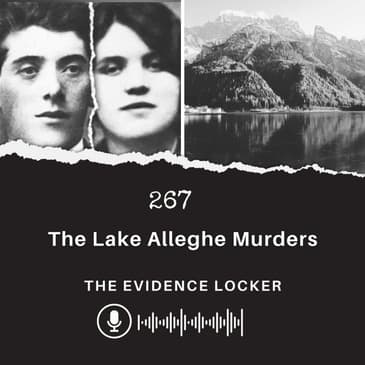
The Alleghe Murders | Italy
On the night of the 18th of November, 1946, a married couple was shot dead in a narrow laneway in the village of Alleghe, high in Italy's Dolomite Mountains. It was the kind of killing the village had never seen before, and it would remain unsolved for another eighteen years.
By the time the truth finally emerged, investigators had traced the killing back more than a decade, to a lakeside hotel and the family who had run it for generations. Along the way, they uncovered two more deaths that had been quietly filed away as accidents and misfortune, and one earlier death ruled a suicide that few in the village had ever truly believed.
More than anything, they uncovered why the case had taken so long to solve. It was not that the clues had been hard to find. It was that the village had powerful reasons to make sure no one found them — and, for a while, those reasons were strong enough to see the one man who came closest sent to prison for it.
Intro Music & Disclaimer
You are listening to: The Evidence Locker.
Thanks for listening to our podcast. This episode is made possible by our sponsors—be sure to check them out for exclusive deals. For an ad-free experience, join us on Patreon, starting at just $2 a month, with 25% of proceeds supporting The Doe Network, helping to bring closure to international cold cases. Links are in the show notes.
Our episodes cover true crimes involving real people, and some content may be graphic in nature. Listener discretion is advised. We produce each episode with the utmost respect for the victims, their families, and loved ones.
The case:
Nestled high in Italy's Dolomite Mountains, the village of Alleghe lies on the shores of a deep alpine lake, surrounded by forests of spruce and larch beneath the towering peaks of Monte Civetta. In winter, heavy snow transforms the surrounding valley into one of northern Italy's most popular ski destinations. During the warmer months, hiking trails wind through wildflower meadows and dense woodland, while the still waters of Lake Alleghe mirror the sheer limestone cliffs rising above. To visitors, it is a landscape of remarkable beauty, one that appears almost untouched by time.
Home to fewer than fifteen hundred permanent residents, Alleghe today relies heavily on tourism, with family-run hotels, cafés and restaurants lining the lakefront and narrow streets weaving between centuries-old buildings that have endured wars, harsh winters and generations of change. But for most of its history, the village depended not on visitors but on forestry, farming and the rhythms of mountain life. Families often stayed in the valley for generations, and in a community this small, almost everyone was connected to everyone else — through blood, marriage, or simply a lifetime of shared history.
Like many isolated alpine villages, Alleghe developed its own quiet customs. Private matters were rarely discussed beyond the family, disputes were usually settled behind closed doors, and outsiders seldom became part of village life overnight. People relied on one another through long winters, loyalties ran deep, and little was ever truly forgotten. News travelled quickly in Alleghe. So did rumour. And so, when it mattered most, did silence.
At the centre of village life stood the Hotel Centrale, a large building on the edge of the lake that served as both a business and a landmark. During the 1930s, it was owned by Fiore Da Tos and his wife, Elvira Riva, whose family occupied a prominent position within the community. Their children, Aldo and Adelina, also lived and worked there, and the hotel functioned as much as a family home as a place of business. Travellers passed through its doors year-round, and generations of villagers had celebrated weddings, wakes and holidays within its walls.
It was there, on the morning of the 9th of May, 1933, that nineteen-year-old Emma De Ventura, a waitress employed at the hotel, was found dead while cleaning one of the guest rooms. She was discovered lying in a pool of blood, with a deep wound to her throat. Nearby, investigators found an empty bottle of iodine and a razor. The doctor who examined her concluded that Emma had first swallowed the iodine and, unable to endure the pain it caused, had cut her own throat rather than face a slower death. The presence of iodine in her stomach appeared to support that theory, and the case was formally closed as a suicide.
Not everyone accepted the explanation. Emma's family struggled to reconcile the official finding with the state in which she had been found. They questioned the position of the razor, the nature of her injuries, and whether a young woman intent on ending her own life would have gone about it in quite the manner investigators described. But in 1933, in a small mountain village where the owners of the Hotel Centrale were among the most influential people in the valley, challenging the conclusions of the authorities was no simple undertaking. Italy at the time was under Fascist rule, and local officials in a village the size of Alleghe depended heavily on the goodwill of prominent families like the Da Tos to keep the peace and keep the tourist trade running smoothly. Without fresh evidence, and without any local official inclined to look harder, the family's doubts went no further than private conversation.
Less than seven months later, tragedy returned to the Hotel Centrale. On the evening of the 4th of December, 1933, the body of twenty-six-year-old Carolina Finazzer was pulled from the cold waters of Lake Alleghe. Carolina was the wife of Aldo Da Tos, and by all outward appearances had settled comfortably into life with one of Alleghe's most prominent families since her marriage. She had disappeared after leaving the hotel, and when she failed to return, concern spread quickly through the village. Investigators found no clear sign of a struggle, and the official inquiry concluded there was insufficient evidence of foul play. Suicide and an accidental fall were both considered. Without witnesses or firm forensic evidence, no conclusion was ever reached, and Carolina's death joined the list of unanswered tragedies that had touched the village that year.
For her family, the explanation never sat comfortably. Carolina had shown no sign of wanting to end her life, and those who knew her struggled to understand how a healthy young woman, familiar with the village and its lakeside paths, could simply vanish into the water without anyone hearing or seeing anything. Like the questions raised after Emma De Ventura's death, theirs faded quietly from the public record, but never entirely disappeared. Two deaths in seven months, both connected to the same family and the same hotel, might have seemed nothing more than a run of misfortune. In a village where names recurred through generations and tragedy sometimes struck families more than once, that was, for a time, exactly how the two were understood.
Thirteen years passed without further incident. Then, on the night of the 18th of November, 1946, the village baker Luigi "Gigio" Del Monego and his wife, Luigia, set out on foot through Alleghe after visiting relatives. The couple never arrived home. The following morning, villagers discovered their bodies in a narrow laneway known locally as La Vói, a short distance from the centre of the village. Both had been shot at close range.
In the immediate aftermath, investigators believed they were dealing with a robbery. The couple's takings from their bakery had disappeared, along with Luigia's earrings, and on the surface the case looked like an opportunistic attack on two people known to carry cash. Suspicion fell on Luigi Verocai, a local man with a violent reputation who had previously been implicated in another homicide and seemed, to investigators at the time, a natural fit for a robbery gone wrong. He was arrested and held for a period, but the evidence against him proved insufficient to sustain a prosecution, and the charges were eventually dismissed. With no other viable suspects and a theory that had already fallen apart once, the double murder was archived as a robbery committed by persons unknown, and it would remain that way for years.
The killing shocked Alleghe. Violent crime was rare in the valley, and the execution-style killing of a married couple on a village pathway was almost unimaginable. Detectives questioned relatives and neighbours, but despite extensive enquiries, no one admitted to seeing anything. As had happened after the deaths at the Hotel Centrale, rumours moved quickly through the village while very little of substance ever reached the official investigation.
Three unexplained deaths across thirteen years, each one closed without a conviction, might easily have been forgotten altogether. They would have been, had it not been for one young journalist who refused to let them go.
Sergio Saviane had known Alleghe since he was a boy, long before he had any reason to think of it as the setting for a story he would spend years of his career chasing. He first arrived in the village in 1939 and spent summers there over the following years, camping by the lake with a group of friends and gradually becoming known to the locals, including the Del Monegos themselves. Luigi and Luigia were people he genuinely considered friends rather than mere acquaintances, and the news of their murder in 1946 affected him personally in a way it could not have affected an outside reporter parachuted in for the story. When the case against Luigi Verocai collapsed and the murder briefly returned to the news in the early 1950s, Saviane, by then a working journalist for the weekly Il Lavoro Illustrato, was sent back to Alleghe in 1952 to investigate further.
What he encountered was a wall of silence. Villagers who might once have spoken freely to a young man they had known since boyhood now grew evasive whenever the subject of the Hotel Centrale or the Del Monegos came up. Saviane pressed on regardless, moving between conversations in bars, card games, and casual encounters on the street, piecing together fragments that no one would state plainly on the record.
He eventually published his findings in an article titled "La Montelepre del Nord," drawing a pointed comparison to the Sicilian town notorious for sheltering the bandit Salvatore Giuliano behind a code of local silence. In it, Saviane argued that the four deaths were not separate tragedies but a single connected chain, the work of one hand rather than a run of unrelated misfortunes.
The article caused an immediate sensation, and an equally immediate backlash. Aldo Da Tos and his brother-in-law Pietro De Biasio, the owners of the Hotel Centrale, sued Saviane for defamation, even though neither man had been named directly in the piece. When the case went to court, Saviane's witnesses either failed to appear or, when they did testify, spoke against him rather than in his support, undone by the same silence he had been fighting to break. He was convicted of criminal libel and sentenced to eight months in prison, along with substantial damages. On paper, his investigation had ended in total failure.
This is, in many ways, the answer to why the case took so long to resolve. It was not simply overlooked. Raising it publicly was actively punished. A journalist who suggested the truth was taken to court and imprisoned for it, in a village where the family he had implicated held real social and economic influence. For years afterward, no official had much appetite for reopening a case that had already cost one man his liberty for asking the wrong questions aloud.
Saviane never stopped believing he had been right, even as his own conviction stood. It would take a very different kind of investigator, working in a very different way, to prove it.
Some years later, a Carabinieri brigadiere stationed at nearby Agordo, Ezio Cesca, began quietly looking into the old case, drawing on the threads Saviane had laid out in his reporting. Cesca understood something his predecessors had not: no one in Alleghe was going to answer direct questions from a uniform, no matter how carefully those questions were phrased. Villagers had watched a journalist go to prison for saying less than what Cesca now suspected, and that lesson had not been lost on anyone.
So Cesca worked differently, patiently, over what amounted to years rather than weeks, building relationships rather than issuing summonses. He spent time in the village off duty, out of uniform, letting conversations happen naturally rather than forcing them. He became friendly with a young woman from Alleghe and, through her, gradually earned the trust of her grandmother, an elderly resident who, it emerged, had witnessed the events of the 1946 killing firsthand, and had carried that knowledge in silence for years.
Speaking to Cesca in confidence, away from any formal interview, the elderly woman described watching three men moving in the darkness on the night the Del Monegos were killed. Two she could not identify. The third she recognised without hesitation: Giuseppe Gasperin, a local man. Confronted with her account, Gasperin eventually gave way under sustained questioning, naming his accomplices as Aldo Da Tos and Pietro De Biasio — the same two men who had, a few years earlier, successfully sued Sergio Saviane for suggesting precisely this.
Gasperin's confession unlocked the rest of the case. Investigators concluded that Aldo Da Tos and Pietro De Biasio were responsible for both the killing of Luigi and Luigia Del Monego and the earlier death of Carolina Finazzer, with Adelina Da Tos also implicated in her sister-in-law's death. Emma De Ventura's case, the one that had started it all back in 1933, could not be formally prosecuted; too many years had passed under the statute of limitations. But investigators, like Saviane before them, believed her death belonged to the same chain of events as the others.
The motive Saviane had pieced together over years of reporting, though it was never proven in a courtroom, reached back into an old family secret. Years before the killings began, Elvira Riva, the hotel's matriarch, had given birth to a son outside of marriage and had arranged for him to be raised elsewhere to avoid gossip. According to Saviane's theory, that son arrived in Alleghe in 1933, by then a grown man, and Emma may have stumbled onto something connected to his presence or his identity — a secret the family had spent decades protecting. It remained speculation, drawn from rumour, record and Saviane's own painstaking reconstruction rather than courtroom evidence, and it was never formally tested at trial.
What could be tested, decades later, were the deaths that Gasperin's confession had reopened. Aldo Da Tos, Adelina Da Tos and Pietro De Biasio stood trial alongside Gasperin himself, whose cooperation had cracked the case open. The proceedings were unlike almost any other Italian murder trial of the period. Witnesses were recalling conversations and sightings from more than a decade earlier, memories that had to be weighed carefully against what little physical evidence still existed. A journalist's supposedly libellous claims from 1952 were now treated as the roadmap that had led investigators to the truth. And a village that had stayed silent for a generation finally, in pieces, began to say what many had known all along.
The defendants' accounts shifted over the course of the proceedings — confessions were made, then retracted, then partially confirmed again as the case moved from the initial trial through appeal. It was, by any measure, a slow and difficult process, complicated by the age of the events and the reluctance of a village still uneasy about turning definitively against one of its most prominent families.
Convictions followed nonetheless. Aldo Da Tos, Adelina Da Tos and Pietro De Biasio, the family that had once run the Hotel Centrale and successfully silenced the one man who tried to expose them, were sentenced to life imprisonment, a verdict upheld on appeal and finalised in 1964. Giuseppe Gasperin, whose testimony had ultimately broken the case, received a thirty-year sentence.
Sergio Saviane, vindicated more than a decade after his own conviction for telling much the same story, went on to write the definitive account of the case in his 1964 book, I misteri di Alleghe. Part journalism and part narrative reconstruction, the book drew on the investigation he had started in 1952, the trial that eventually followed, and his own long and complicated relationship with a village that had once taken him to court for pursuing the truth. Saviane went on to a long career as a journalist and television critic, but he was, by his own account, forever shaped by the years he spent chasing the Alleghe case and by the prison sentence it had cost him before it was ever proven right.
His book remains the primary reference point for the case today. It later inspired a television dramatisation, Buio nella valle, broadcast in 1984, as well as a modern stage monologue retracing Saviane's original investigation, performed under the title Ho giocato a carte con l'assassino — "I played cards with the murderer." Some later reconstructions of the case have questioned certain details of Saviane's own theory of the motive, particularly around the fate of Elvira Riva's illegitimate son, but the broad shape of what he uncovered — that the deaths were connected, and that the Hotel Centrale's owners were responsible — was ultimately confirmed by the court.
For the village itself, the convictions brought something closer to relief than celebration. Many residents had spent their entire lives knowing, in one form or another, that the official version of events at the Hotel Centrale was incomplete, without ever being willing to say so to an outsider, let alone a court. Once the verdicts were handed down, some spoke of a weight lifting from the community. Others resented the renewed attention the case brought to Alleghe, and the reputation of a village where four murders could pass unpunished for a generation. Both reactions, in their way, were consistent with everything Saviane and Cesca had encountered while trying to get anyone to talk in the first place.
Today, Alleghe remains one of the most beautiful villages in the Italian Alps. Visitors continue to arrive throughout the year to ski beneath Monte Civetta, hike the surrounding mountains and stroll beside the tranquil waters of Lake Alleghe. The Hotel Centrale still stands overlooking the lake, a familiar landmark to tourists who may know little of the history attached to it.
Among local residents, the murders have gradually become woven into village folklore. Some speak of strange lights reflected across the lake after dark, or of unexplained footsteps along the old paths where victims were last seen. There is no evidence to support any of it, and these stories remain exactly that: stories, passed from one generation to the next.
Perhaps the real mystery of Alleghe was never whether the village was haunted. It was how so many secrets survived for so long, in plain sight, inside a community small enough that everyone already knew. In the end, cracking it took two very different men, a generation apart: a stubborn young journalist who was punished for telling the truth too soon, and a patient carabiniere who understood that the only way into Alleghe's silence was to stop demanding answers and start earning trust.
Outro:
If you'd like to dive deeper into this case, check out the resources we used for this episode in the show notes.
Don't forget to follow us on social media for more updates on today's case -- you can find us on Facebook, Instagram, TikTok and X. We also have a channel on YouTube where you can watch more content.
If you enjoy what we do here at Evidence Locker, please subscribe on Apple Podcasts or wherever you're listening right now and consider leaving us a 5-star review.
This was The Evidence Locker. Thank you for listening!
Resources
Documentary
Mysteries of Alleghe -- Part 1
Mysteries of Alleghe -- Part 2
Mysteries of Alleghe - Part 3
Web
Wikipedia
Articles
I delitti di Alleghe
I delitti di Alleghe: la catena di omicidi che 90 anni fa macchiò il paesino delle Dolomiti
The mysteries of Alleghe
The dark side of Alleghe
Created & Produced by Sonya Lowe
Narrated by Noel Vinson
Music: "Nordic Medieval" by Marcus Bressler
Background track: Doblado Studios: https://www.youtube.com/c/DobladoStudios
©2026 Evidence Locker Podcast
All rights reserved. This podcast or any portion thereof may not be reproduced or used in any manner whatsoever without the express written permission of the publisher except for the use of brief quotations in a podcast review.