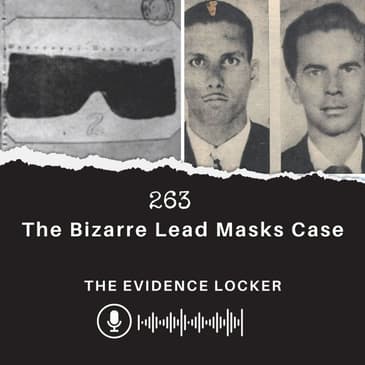
On the afternoon of August 20th, 1966, eighteen-year-old Jorge da Costa Alves climbed a steep, grassy hill on the outskirts of Niterói, a city facing Rio de Janeiro across Guanabara Bay. It was a Saturday, and Jorge had come to Vintém Hill, to fly a kite. The hill overlooking one of Niterói's suburban neighbourhoods, and from its summit, a person could see clear across the bay to the sprawl of Rio itself. As Jorge worked his kite string among the tall grass, he noticed what looked like two bundles of clothing lying in the weeds a short distance away. Thinking little of it, he wandered over. What he found made him drop the kite altogether.
Two men lay side by side on the hillside, dressed as though for a business meeting. They wore dark suits, waterproof raincoats buttoned over the top, and something Jorge had never seen before: crude masks made of sheet lead, cut roughly into the shape of eyeglasses, covering their eyes. There was no blood. No sign of a struggle. Just two ordinary-looking men, laid out neatly in the grass, as though they had simply lain down to rest and never gotten up again.
Jorge ran for help. What followed would become one of Brazil's most enduring unsolved mysteries – a case that has been picked apart by police, journalists, ufologists and skeptics for nearly sixty years, and one that, to this day, has never been fully explained.
You are listening to: The Evidence Locker.
Thanks for listening to our podcast. This episode is made possible by our sponsors—be sure to check them out for exclusive deals. For an ad-free experience, join us on Patreon, starting at just $2 a month, with 25% of proceeds supporting The Doe Network, helping to bring closure to international cold cases. Links are in the show notes.
Our episodes cover true crimes involving real people, and some content may be graphic in nature. Listener discretion is advised. We produce each episode with the utmost respect for the victims, their families, and loved ones.
Niterói in the 1960s was, and remains, one of the more affluent municipalities in the Rio de Janeiro metropolitan area. Perched on the eastern shore of Guanabara Bay, it was a city of colonial churches, quiet residential streets and hillside neighbourhoods with sweeping views of the water. Vintém Hill sat within a suburban pocket of the city, close enough to houses that a teenager could walk up for an afternoon with a kite, yet wild enough that its slopes were thick with grass and low brush.
The two men found on that hillside were not from Niterói at all. They were identified as Manoel Pereira da Cruz, aged thirty-two, and Miguel José Viana, aged thirty-four, both electronics technicians from Campos dos Goytacazes, a town roughly two hundred kilometres to the northeast. Manoel and Miguel repaired radios and televisions for a living, a respectable and increasingly important trade in a country where television ownership was expanding rapidly through the 1960s. Both men had studied electronics in São Paulo, and Miguel had even completed a correspondence course through an American institution. Colleagues considered them skilled and reliable. Neither had a criminal record, and neither was known to police before that August weekend.
Manoel was married to a woman named Neli, and by most accounts he was a quiet, private man who had been going through what family members later described only as a difficult period – not financial, but something closer to a personal or spiritual restlessness. Miguel was married to Elsa Gomes Viana and had a reputation among friends as good-natured and easy-going, a man who enjoyed a challenge and did not shy away from risk. The two technicians were close friends as well as colleagues, and it was this friendship, police would come to believe, that carried them both to Vintém Hill.
On the evening of Tuesday, August 16th, Miguel told his wife Elsa that he and Manoel needed to travel to São Paulo the following day for work. It was not an unusual statement. Both men made frequent trips to São Paulo to purchase parts and equipment for their business, and Elsa had no reason to question it. But the next morning, Wednesday, August 17th, the two men did not board a bus to São Paulo. Instead, they travelled in the opposite direction, toward Rio de Janeiro and, ultimately, Niterói – a city where, as far as investigators could later determine, they had no professional business at all.
The two men arrived in Niterói at around two-thirty in the afternoon. From there, detectives were able to reconstruct their movements with some precision, largely thanks to receipts found later in their pockets. They first visited an electronics supply shop, apparently to buy small components. They then went to a clothing store and purchased two identical waterproof raincoats – an odd choice, witnesses would later note, given that the sky that afternoon was clear. Finally, they stopped at a small bar, where they bought a single bottle of mineral water. Under Brazil's bottle-deposit system of the time, customers paid a small deposit on glass bottles, refunded when the empty bottle was returned to the vendor – and the men kept their receipt, suggesting they expected to bring the bottle back.
The waitress who served them later told police that the two men seemed unusually nervous. One of them, she said, kept glancing at his watch, as though they were racing against some kind of deadline. It was the last confirmed sighting of Manoel Pereira da Cruz and Miguel José Viana alive. Sometime after leaving that bar, in the fading light of a Wednesday afternoon, the two men made their way up the slopes of Vintém Hill. Three days later, Jorge da Costa Alves would stumble across what remained of them.
News of the discovery spread through Niterói within hours, and by the time officers, firemen and reporters began the climb up Vintém Hill, a small crowd had already gathered at its base. The terrain proved difficult, thick with grass and loose stone, and it took the recovery team close to two hours to reach the bodies and begin their work. What they found only deepened the strangeness of the case.
Manoel and Miguel lay close together, their bodies partially covered by the grass around them, showing no visible wounds, no bruising, no sign that either man had fought for his life. Investigators noted this immediately: whatever had killed them, it did not appear to have been violent. Beside the bodies, police found a small plastic bag containing two wet towels and the now-empty water bottle. Police recovered a considerable amount of cash, far more than the two men would likely have needed for the journey. Accounts of the exact figure vary, but some investigators suggested it was enough to have covered the price of a modest used car. Only a small portion of that money was ever found on the men; a large share of whatever cash they had originally been carrying was never accounted for.
Then there were the masks. Fashioned from thin sheets of lead and cut by hand into a rough approximation of a pair of glasses – without stems, simply shaped to sit across the bridge of the nose and cover the eyes – they bore no obvious relation to any protective equipment police or forensic staff recognised. They were not welding masks. They were not the kind of shielding used around radioactive material, which typically covers the entire head and includes viewing ports rather than blocking sight altogether. They appeared to have been made for a single, specific purpose: to blind the wearer completely, and nothing more.
Perhaps the most puzzling item recovered from the scene was a small notebook. One page was filled with what looked like electronics part numbers, the kind of shorthand two working technicians might use to order components – ordinary, at least on its surface. But another page carried a short, cryptic set of instructions written in Portuguese. Translated, it read: "
16:30, be at the specified place.
18:30, swallow capsules; after the effect, protect metals; await signal, mask." A further page appeared to lay out a dosing schedule for the capsules across different days of the week. No capsules were ever found at the scene, and no drugs, poisons or other substances were recovered from the men's pockets or from the bag beside them.
The investigation, led by local police officers José Venâncio Bittencourt and Idovan Ferreira, ran quickly into a wall that would prove impossible to fully overcome: the autopsy. Weeks passed before medical examiners were able to conduct a full post-mortem, reportedly because the coroner's office was overburdened with other cases at the time. By the time the bodies were finally examined, decomposition had advanced to the point that internal organs could not be reliably tested. Toxicology screening, which might have revealed exactly what the two men had ingested – if anything – was never carried out. It remains, to this day, one of the great missed opportunities in the case: had the notebook's reference to "capsules" been followed up promptly with proper forensic testing, investigators might have had a definitive answer within weeks. Instead, that answer was lost to time and bureaucratic delay.
With no toxicology, no wounds, and no witnesses to the men's final hours on the hill, investigators had almost nothing solid to work from beyond the objects left at the scene and the accounts of people who had known Manoel and Miguel in life. It was in these interviews that a far stranger picture of the two technicians began to emerge – one that had nothing to do with robbery, jealousy, or any of the usual motives detectives might expect. Still, nothing recovered from the scene suggested that either man expected this to be a one-way journey.
Miguel's brother, Herval Viana, travelled to Niterói to identify and claim the bodies. He told police that Miguel had spoken to him in the weeks before his death about an important experiment he intended to carry out, though he had never explained what it involved. Herval described his brother as having seemed quiet and troubled in his final days, as though bracing himself for something significant. Other relatives, by contrast, insisted that both men had seemed entirely normal and gave no impression of being involved in anything dangerous or illicit.
It was a friend and associate of both men, Élcio Correia Gomes, who provided investigators with the clearest window into what Manoel and Miguel may have believed they were doing on Vintém Hill. Gomes, a follower of Kardecist spiritism – a religious movement rooted in the writings of the French educator Allan Kardec, which teaches that spirits of the dead can communicate with the living – told police that he had introduced Manoel to spiritist practice during a difficult period in Manoel's life. Gomes went further, describing himself, Manoel and Miguel as a small circle of self-styled "scientific spiritualists," a group interested in using structured, almost laboratory-like methods to pursue contact with spirits, or, in some retellings, with other worlds entirely.
Investigators learned that around two months before the men's deaths, the trio had reportedly built some kind of device in the garden of Manoel's home, an apparatus that exploded during testing. What the device was meant to do was never established with any certainty, though its failure appears to have been treated by the group as a setback rather than a reason to abandon their pursuits. Searching Miguel's home workshop, police also found the tools and offcuts of lead sheeting that matched the crude masks recovered from Vintém Hill, along with a book titled Vida no Planeta Marte – Life on Planet Mars – purportedly dictated to its author by a spirit calling itself "Ramatís." Certain passages inside had been underlined, particularly those describing an "intense luminosity" said to accompany contact with higher spiritual planes.
Taken together, these details suggested a working theory, one that Brazilian investigators themselves would eventually settle on: that Manoel and Miguel had climbed Vintém Hill that August evening believing they were about to take part in some kind of spiritual or paranormal experience, one they expected to be accompanied by an overwhelming burst of light. If they anticipated being blinded by that light, and believed – rightly or wrongly – that lead could somehow shield their eyes from it, the hand-cut masks would have made a grim kind of sense to them, whatever a modern physicist might say about lead's actual usefulness against visible light. The capsules referenced in the notebook, investigators reasoned, may have been intended to bring on an altered state of consciousness ahead of this anticipated event – whether a hallucinogen, a sedative, or something else. Roughly two weeks after the deaths, a self-described yoga instructor told the São Paulo newspaper Folha de São Paulo that it was common within Rio's spiritist circles to use psychedelic substances in pursuit of visionary or transcendent experiences, and offered his opinion that Manoel and Miguel had most likely died of an accidental overdose taken in that context.
It's worth pausing here to be honest about what can and cannot be verified. No capsules, drugs or other substances were ever recovered from the scene. No toxicology report exists to confirm what, if anything, entered either man's bloodstream that evening. The theory of ritual drug use explains the physical evidence more comprehensively than any competing idea – the masks, the notebook, the timed instructions, the underlined passages about luminosity – but it remains an inference built from circumstantial detail, not a conclusion drawn from hard forensic proof. Brazilian police effectively closed their investigation without laying any charges, since there was no evidence that a third party had been involved in the men's deaths, and no crime, in the legal sense, appeared to have been committed.
Inevitably, in a case with this many open questions, other theories filled the gaps left by the missing toxicology. In the days following the discovery of the bodies, at least two Rio newspapers reported that a local woman claimed to have seen a glowing, orange object moving erratically in the sky above Vintém Hill on the night the two men were believed to have died. Other Niterói residents came forward in the weeks that followed with similar accounts of unusual lights. For ufologists, this was enough to draw a line connecting Manoel and Miguel's deaths to extraterrestrial visitation – perhaps the two men had gone to the hill hoping to make contact, and had instead met with something far more dangerous than they anticipated.
There is no way to disprove a UFO sighting reported after the fact by someone with no other evidence to offer, but there is also no way to responsibly connect it to the deaths on the hill. Reports of strange lights are common in the aftermath of any high-profile mystery, and nothing about an unidentified light explains lead masks, a notebook, or capsules that were never found. What can be said is that the timing of these reports fed a growing public appetite for a supernatural explanation, one strengthened by an earlier and stranger detail entirely.
Roughly two months before their deaths, on June 13th, 1966, residents of Atafona Beach, close to the men's hometown of Campos dos Goytacazes, reported a loud explosion accompanied by a bright flash in the night sky. Some fishermen in the area claimed to have seen a luminous object fall into the sea. The event drew enough attention that Brazil's naval and air intelligence services reportedly looked into it, along with reports of unregistered radio transmissions picked up in the area the night before. Élcio Gomes would later tell police that this explosion was connected to the trio's own experiments – the very device that had blown up in Manoel's garden – rather than to any external phenomenon. If Gomes was telling the truth, the Atafona incident had a far more mundane origin than the flying saucer stories that grew up around it. But the coincidence of timing, location and subject matter meant the two events became permanently entwined in the retelling of the case.
Investigators also turned up an unsettling precedent. Four years earlier, in 1962, another electronics technician, a man remembered in surviving accounts only as Hermes, had been found dead on a different hill near Niterói, also wearing a lead mask strikingly similar to the ones found with Manoel and Miguel. Details about Hermes's case are thin, and no clear account of his cause of death survives in the record, but its similarity to the 1966 deaths suggested to some investigators that this practice of masked, hilltop ritual was not confined to one small circle of friends, but was part of a broader, if obscure, subculture within Rio's spiritist and occult communities of the period.
By the close of 1966, Brazilian authorities had reached the limit of what the available evidence could support. Police chief Idovan Ferreira's final assessment held that the men had most likely died while pursuing some form of parapsychological experiment – an attempt to prove the existence of the soul, achieve telepathic contact, or reach an altered state of consciousness – through the ingestion of an unidentified substance carried in the mineral water they had purchased shortly before climbing the hill. It was, in essence, an educated guess dressed in official language, an acknowledgment that the how of the men's deaths could be inferred, even if it could never be proven beyond doubt.
No trial ever took place, because no suspect was ever identified and no evidence pointed toward homicide. Manoel Pereira da Cruz and Miguel José Viana were buried at Caju cemetery in Campos dos Goytacazes, among the town where they had lived, worked and raised their families. Their widows, Neli and Elsa, were left to grieve husbands whose final hours remained a mystery even to the people who had known them best. For Herval Viana, his brother's death would always be tied to the "seemingly meaningless things" Miguel had confided in him in the weeks before – fragments of a bigger picture that Herval, like everyone else, was never able to complete.
In the decades since, the case has taken on a life well beyond the borders of Niterói. It has been the subject of magazine features in Cruzeiro and Manchete, retrospective television specials such as Linha Direta's 2004 investigation into the case, and an enduring stream of articles, documentaries and podcast episodes – of which this is only the latest – all circling the same unanswered question. Skeptical researchers, including American writer and podcaster Brian Dunning, have pushed back against the wilder end of the theorising, pointing out that lead sheeting offers no meaningful protection against visible light or radiation of the kind two hobbyist technicians could plausibly have anticipated, and that a single uncorroborated UFO sighting reported after a tragedy is far from proof of anything. What most careful researchers agree on is this: two friends, drawn into a small, earnest, and ultimately fatal circle of amateur spiritual experimentation, climbed a hill together expecting to witness or take part in something extraordinary. Whether that something was contact with the dead, with another planet, or simply the product of two overactive imaginations feeding off each other, we will likely never know.
What makes the Lead Masks Case endure isn't spectacle for its own sake – it's the quiet, mundane ordinariness of the men at its centre. Manoel and Miguel weren't cult leaders or con men. They were tradesmen, husbands, and friends, the kind of men their neighbours would have nodded to on the street without a second thought. Somewhere between their ordinary daily lives and the extraordinary circumstances of their deaths lies a gap that neither forensic science nor sixty years of speculation has ever managed to close.
If you'd like to dive deeper into this case, check out the resources we used for this episode in the show notes.
Don’t forget to follow us on social media for more updates on today's case – you can find us on Facebook, Instagram, TikTok and X. We also have a channel on YouTube where you can watch more content.
If you enjoy what we do here at Evidence Locker, please subscribe on Apple Podcasts or wherever you're listening right now and consider leaving us a 5-star review.
This was The Evidence Locker. Thank you for listening!