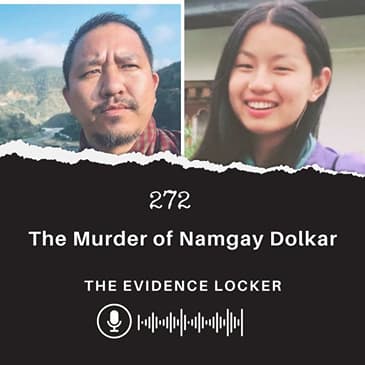
On Monday morning, the 14th of August 2023, retired civil servant Singye Wangchuk went to a police station in Thimphu to report that his 24-year-old daughter was missing. Namgay Dolkar had left the family home at around half past five the previous evening and had not returned. Through the night, Singye had tried her phone repeatedly, hoping each time that she would answer or that the device would simply come back online. By morning, he had also contacted her workplace and learned that she had not arrived there either. Namgay was an adult with a job, friends and plans of her own, but this was sufficiently unlike her for her father to know that something was wrong. He approached Bhutan Telecom for help, and the last available location from her phone pointed towards Semtokha, on the southern side of the capital. Singye did not wait at home for somebody else to search. He went to the area himself, following a rough road above the highway to a secluded place where couples were known to meet, and looked for his daughter. There was no sign of her.
The Royal Bhutan Police began examining Namgay's recent calls and messages, and one name quickly became important. Sonam Norbu was a married man in his late thirties, a former teacher and education entrepreneur who had once employed Namgay. The two had been in a relationship for about six months. When police first questioned him, Sonam said that Namgay had wanted to meet him on the Sunday evening and that he had booked accommodation for them, but she had failed to appear. He also gave police an account of his own movements, saying that he had visited his wife's sick mother before returning home. It was a version that might have removed him almost entirely from Namgay's final hours, had the city not recorded his car moving in a very different direction. CCTV placed his vehicle near Namgay's neighbourhood shortly after five o'clock and later showed it travelling south out of Thimphu. By approximately
9:20 that night, the same vehicle was back in the city. As investigators began putting those images beside Sonam's statement, his account of the evening started to change.
South of Thimphu, the Wang Chhu runs through a steep Himalayan valley, following the road as the capital gives way to wooded slopes and scattered settlements. August is monsoon season in Bhutan, and after weeks of summer rain the river can be swollen, cold and fast. Near Khariphu, roughly twenty kilometres from central Thimphu, a bridge carries the road across the water. It was about five hundred metres downstream from this bridge that Namgay Dolkar was found, lying face down in the river and caught against a log. Sonam would eventually tell police that she had jumped from the bridge after an argument. The injuries on Namgay's body, however, would force investigators and three levels of Bhutan's courts to consider a very different sequence of events. This is the murder of Namgay Dolkar.
You are listening to: The Evidence Locker.
Thanks for listening to our podcast. This episode is made possible by our sponsors—be sure to check them out for exclusive deals. For an ad-free experience, join us on Patreon, starting at just $2 a month, with 25% of proceeds supporting The Doe Network, helping to bring closure to international cold cases. Links are in the show notes.
Our episodes cover true crimes involving real people, and some content may be graphic in nature. Listener discretion is advised. We produce each episode with the utmost respect for the victims, their families, and loved ones.
Bhutan is often presented to the outside world through a handful of striking images: snow-capped Himalayan peaks, Buddhist monasteries clinging to cliffs, prayer flags strung across mountain passes and the imposing dzongs that have served for centuries as fortresses, monasteries and centres of government. The country is also famous for the philosophy of Gross National Happiness, developed as an alternative way of thinking about national progress. Yet the Bhutan in which Namgay grew up was not frozen in that postcard image. It was changing quickly. Thimphu had expanded along the narrow valley of the Wang Chhu; mobile phones, social media and better roads had altered everyday life, and education increasingly offered young Bhutanese opportunities their parents' generation had not had. Many looked overseas for postgraduate study and work, particularly to countries such as Australia, and Namgay's own career placed her directly inside that new outward-looking Bhutan.
Namgay graduated from Royal Thimphu College in July 2021 with a Bachelor of Arts in Political Science and Sociology. Those closest to her remembered a young woman who was bright, confident and unusually capable when something practical needed to be done. Singye had spent twenty-nine years in the civil service before retiring, and he described Namgay as the apple of his eye. She helped an aunt negotiate the permits and paperwork involved in building a house, took relatives to hospital when they were unwell and discussed family property with her father as though the future of the household was something they were planning together. She was equally serious about building a future of her own. After university she worked for a private organisation, and in January 2023 she moved to an education consultancy that helped Bhutanese students apply to study in Australia. Because of her strong English, she became a Statement of Purpose Coordinator, helping applicants turn their education, ambitions and plans into the personal statements required by overseas institutions. Within six months she had been promoted, and her salary was due to rise again in September.
Namgay was considering becoming one of those overseas students herself. According to her father and a close friend, she hoped eventually to complete a master's degree abroad, with the United States among her preferred options and Australia also under consideration. Five days before she died, she contacted a mutual friend in Australia to ask about the possibility of going there, while she and another friend were making plans for a trip to Nepal in September. These were ordinary conversations about work, travel and study, but after her death they became painfully important because Sonam's eventual explanation depended on the claim that Namgay had taken her own life. Her family rejected that from the beginning. They knew the woman who was making those plans, arranging family business and preparing for another promotion, and Singye was so determined that the public should understand who his daughter had been that he allowed a newspaper to publish her photograph. He did not want Namgay reduced to a name in a crime report; he hoped that somebody who had seen her on the Sunday evening might recognise her face and come forward.
The man at the centre of the investigation had also built a life around education. Before entering the private sector, Sonam Norbu had spent about twelve years as a teacher, and during the COVID-19 pandemic he became associated with the Volunteer Teachers of Bhutan movement, or VTOB. As schools closed and ordinary classroom teaching became impossible, the group mobilised teachers to help provide lessons and support remotely, and Sonam appeared publicly as one of its organisers. Contemporary coverage presented him as an educationist and community-minded figure; his family would later point to that record when defending his character.
By 2023, however, Sonam had left the civil service and was running a private organisation where Namgay had previously worked. He was married and had children, and the relationship with his much younger former employee was being kept from his wife. Messages later examined during the case suggested tension over the secrecy surrounding the affair, including Namgay's threat to expose the relationship and Sonam's possessiveness about her social life. What began as a private complication in two lives would eventually become central to the prosecution's argument about motive.
The surviving communications show that the meeting on the 13th of August had not been spontaneous. On the previous day, Sonam had messaged Namgay on Telegram asking when they should meet on Sunday. The Supreme Court later found that he booked two hotel rooms in Thimphu that day and subsequently cancelled them. At
5:08 in the afternoon, he sent Namgay a message saying that he had reached the NPPF colony where she lived. CCTV then recorded Namgay leaving home and walking towards the road, while Sonam's vehicle was seen near the entrance to the colony. The final message between their phones was the one sent at
5:08. From that point, investigators had to rely on cameras, telephone records, Sonam's changing statements and the evidence recovered from Namgay's body to reconstruct the next four hours.
At first Sonam denied that he had met her at all. He told police that he had gone elsewhere to visit his mother-in-law and returned home, and at one stage suggested that Namgay might have travelled to Nepal. When investigators showed him CCTV evidence that contradicted his account, he changed it. He now said that he had gone towards Yusipang looking for Namgay but had failed to find her. Prosecutors later tested this explanation in a particularly practical way, driving the route themselves at different speeds and comparing their travel times with the CCTV record. Even their slowest reconstruction left a substantial period unexplained. The prosecution argued that Namgay had been inside Sonam's vehicle and that its tinted windows had prevented the cameras from showing her clearly. Whatever happened during that period, the vehicle eventually travelled south, through the Thimphu gate and towards Khariphu, before returning to the city later that evening.
Only after Namgay's body was recovered did Sonam give police an account that placed the two of them together. He said that they had driven south and parked near Khariphu, where an argument became physical. According to his version, Namgay tried to harm herself using the vehicle's seat belt and he grabbed her around the neck during the struggle, releasing her once she had calmed down. He claimed that she then left the vehicle, went onto the bridge and jumped into the river. Yet nothing Sonam did afterwards resembled the actions of a man who had just watched someone he knew disappear into dangerous monsoon water. He did not go into the river after her, summon emergency services or seek help from people living nearby, and he did not contact Singye to tell him what had happened. Instead, Sonam drove back to Thimphu and returned home to his wife, while Namgay's father spent the night calling a phone that would never be answered. Sonam later said that he had panicked because he was afraid of getting into trouble.
The bridge itself became part of the prosecution case. Lawyers from the Office of the Attorney General travelled to Khariphu and examined the route at around the same time of evening that Sonam had been there. The Bailey bridge was not an easy place from which to leap unnoticed in darkness: its structure and broad sides made climbing over awkward, and prosecutors argued that a person attempting to do so would be likely to strike part of the bridge. Namgay's body did not carry the sort of corresponding injury they expected from that scenario. More important still was the post-mortem examination. There were bruises beneath her jaw and on both sides of her neck, abrasions across the front of her throat, injuries to her upper chest and shoulder and a laceration inside her lower lip.
The forensic report described signs of pressure applied in more than one way, including injuries consistent with manual strangulation and smothering. The bleeding, swelling and bruising around the wounds showed that many had been inflicted while Namgay was alive.
Her body had been recovered from a river, but the medical evidence did not support drowning as the obvious cause of death. The examination found signs of asphyxia, including congestion and petechial haemorrhages, and concluded that fatal pressure to the neck was responsible. Although the pathologist could not exclude drowning with absolute certainty, the absence of the usual findings made it far more likely that Namgay had died before she entered the water. The pattern of injury also sat uneasily beside Sonam's description of a single desperate struggle involving a seat belt. There were marks from different forms of pressure, including force around the mouth, and later court reporting referred to severe bruising and fractures that were inconsistent with suicide. To Singye, the forensic findings confirmed what he had believed from the moment he learned how his daughter had been found. Speaking publicly soon after her death, he said simply that Namgay had not killed herself; she had been murdered.
The investigation also moved into the digital life that Namgay and Sonam had tried to keep private. Police were able to gain some access to Namgay's WhatsApp and Telegram accounts through her phone number, but the useful material was limited. Sonam told investigators that WhatsApp had mainly been used for work and that the affair was conducted through Telegram, a platform on which either participant could remove the entire conversation history without leaving the sort of visible deletion notice familiar to users of other messaging services. Namgay also had several Facebook accounts that were not linked to the number police possessed, and investigators could not simply enter them through her phone credentials. Then came a small but unsettling detail: after Namgay was dead, somebody changed the profile picture on one of her Facebook accounts.
Contemporary reporting did not establish who had done it. Police were also trying to recover deleted information from Sonam's phone, but the device and its software made forensic extraction difficult. The case would therefore never depend on one recovered message or one decisive digital discovery; it was built from the way many smaller pieces fitted together.
Sonam was charged with murder, but when the Thimphu District Court delivered its judgment in December 2024, it found that the prosecution had not proved premeditated malice to the standard required for that offence. The court nevertheless concluded that Sonam had unlawfully killed Namgay, convicting him of voluntary manslaughter and imposing a sentence of fourteen years, eleven months and twenty-nine days.
The distinction mattered. Under Bhutanese law, the prosecution needed more than proof that Sonam had caused Namgay's death; for murder, it had to establish that the killing had been deliberate and premeditated. The District Court accepted the chain of forensic and circumstantial evidence but was not satisfied that the planning element had been conclusively demonstrated. Neither side was content with the result. Sonam appealed the conviction, maintaining his innocence, while the Office of the Attorney General appealed in the opposite direction and asked the High Court to restore the original murder charge.
That appeal brought renewed attention to the hours before Namgay died. The prosecution pointed to the Telegram message arranging the meeting a day in advance, the hotel bookings, Sonam's arrival at the NPPF colony and the CCTV footage showing Namgay walking towards the road where his vehicle was waiting. It also relied on what happened afterwards: the journey south, the return to Thimphu without Namgay, the failure to seek help, the false statements to police and the successive revisions to his story as each new piece of evidence appeared. On the 27th of March 2025, the High Court overturned the manslaughter finding and convicted Sonam Norbu of murder, sentencing him to life imprisonment. The court concluded that the circumstantial evidence, considered as a whole, established premeditated malice beyond reasonable doubt. It rejected the suicide account and noted that if Namgay really had jumped into the river in front of him, Sonam had made no attempt to save her or alert anyone who could.
Sonam took the case to Bhutan's Supreme Court, where the question of intent was examined once again. On the 16th of February 2026, the country's highest court upheld the murder conviction and the life sentence. Its judgment went further in explaining why it believed Sonam had planned Namgay's death, concluding that he intended to remove the threat the affair posed to his family life so that he could continue with his wife and children without future complications. The court relied on the arrangements made before the meeting, the CCTV and telephone evidence, the journey to Khariphu and Sonam's conduct after Namgay disappeared. There had been no eyewitness to the killing and no confession to murder, but Bhutan's courts were entitled to convict on a sufficiently strong chain of corroborated circumstantial evidence. By the time the Supreme Court ruled, that chain had been examined at every level of the country's judiciary, first producing a manslaughter conviction and then, on appeal, a final finding of murder.
For Singye Wangchuk, the legal process lasted two and a half years, but the loss it was trying to account for had happened in a single evening. He attended to the case closely, challenged the suggestion that Namgay had taken her own life and continued speaking about the daughter he knew outside the courtroom. By the time of the High Court decision, he told reporters that the effect of her death had been overwhelming and that he struggled to get through ordinary life without thinking about her. There was something especially cruel in the contrast between the public debate over Namgay's state of mind and the mundane evidence of the future she had been constructing: the promotion due in September, the trip to Nepal, the conversations about postgraduate study, the family matters she helped her father manage and the applications she prepared at work for other young Bhutanese hoping to begin lives overseas. Her profession required her to help strangers explain where they had come from and where they hoped to go. Namgay had been doing exactly the same thing in her own life.
In the years after the murder, Sonam's earlier public reputation inevitably became part of the way the case was discussed. His family emphasised the teacher who had helped mobilise colleagues during the pandemic, the educationist and social worker they knew, while Namgay's father saw those descriptions through the knowledge of what the courts had found he had done to his daughter. The contradiction is one of the more unsettling aspects of the case, not because a respectable public life somehow makes violence mysterious, but because people are rarely known in only one setting. The man organising teachers, the married father protecting a secret relationship and the defendant repeatedly changing his account were not separate characters. They were the same person, observed under very different circumstances. The courts ultimately judged him not by the reputation he had built before August 2023, but by the evidence of what happened after he arranged to meet Namgay that Sunday afternoon.
The last confirmed communication between Namgay and Sonam came at
5:08 pm, when he told her that he had arrived near her home. Within minutes she was on the road, heading towards the place where CCTV recorded his vehicle. Four hours later, he was back in Thimphu without her. The following morning, while Singye searched near Semtokha and tried to understand why his daughter had vanished, police began tracing the same journey in reverse through calls, cameras and roads leading south. It ended at Khariphu, beside a river swollen by the monsoon, where Namgay's body had been caught against a log before the current could carry her farther away. The river had not concealed what happened. Her injuries survived the water, the cameras preserved the movement of the car, and the contradictions in Sonam's accounts accumulated each time he tried to explain them.
Namgay Dolkar was twenty-four years old when she died. She had a degree, a new career, another promotion ahead of her and plans that reached well beyond Bhutan. Those plans, rather than the story told about her after her death, are perhaps the clearest picture of the life she was living when it was taken from her.
If you'd like to dive deeper into this case, check out the resources we used for this episode in the show notes.
Don’t forget to follow us on social media for more updates on today's case – you can find us on Facebook, Instagram, TikTok and X. We also have a channel on YouTube where you can watch more content.
If you enjoy what we do here at Evidence Locker, please subscribe on Apple Podcasts or wherever you're listening right now and consider leaving us a 5-star review.
This was The Evidence Locker. Thank you for listening!